



What's Happening?
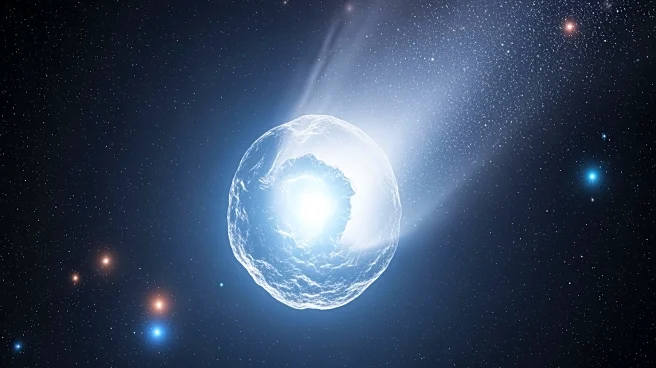
Interstellar comet 3I/ATLAS, the third known object from another star system to pass through our solar system, is being closely studied by astronomers. Discovered in July 2025, the comet's hyperbolic trajectory confirms its interstellar origin. Observations
from NASA's Hubble Space Telescope and ESA's Juice mission reveal a chemically complex and active comet, with a nucleus between 440 meters and 5.6 kilometers across. The comet's speed and trajectory suggest it will not return once it leaves the solar system.
Why It's Important?
3I/ATLAS provides a rare opportunity to study material from another star system, offering insights into the chemistry and formation of planetary systems. The comet's activity and composition could help scientists understand the processes that occur in interstellar space and how they compare to those in our solar system. This knowledge is crucial for refining models of comet formation and evolution, as well as for understanding the potential for life-supporting chemistry beyond Earth.
What's Next?
As 3I/ATLAS approaches its closest point to Earth on December 19, 2025, astronomers will continue to gather data using various telescopes and spacecraft. ESA's Juice mission is expected to provide detailed observations in early 2026, which will enhance our understanding of the comet's composition and behavior. These findings will contribute to ongoing research into interstellar objects and their role in the broader cosmic environment.