





What's Happening?
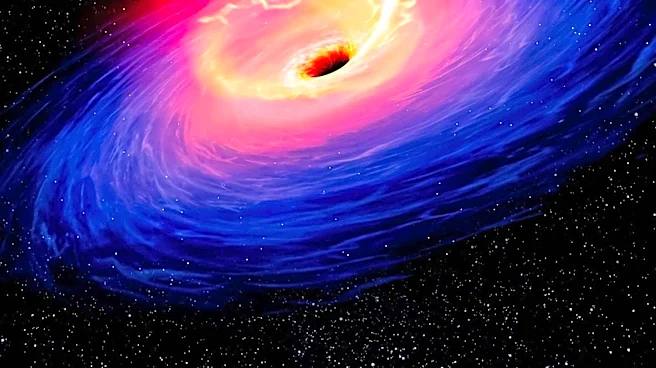
NASA's Neil Gehrels Swift Observatory has observed a supermassive black hole, located unusually far from the center of its galaxy, as it devours a star. This event, known as a tidal disruption event, is rare and marks the first time such an occurrence
has been detected so far from a galactic core. The black hole, with a mass approximately 1 million times that of the Sun, was first identified by the Zwicky Transient Facility in November 2025. The flare produced by the star's destruction was exceptionally bright, temporarily shining with the brilliance of about 10 billion suns. This discovery validates a new technique for identifying supermassive black holes that are not located at the centers of galaxies.
Why It's Important?
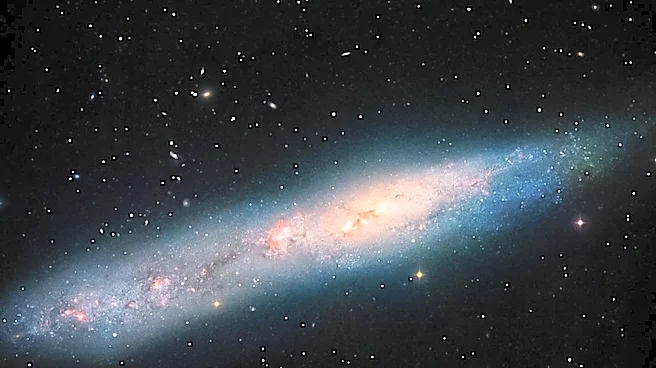
The detection of a supermassive black hole far from a galactic center challenges existing assumptions about the locations of these cosmic phenomena. It suggests that black holes can exist in unexpected places, potentially due to past galactic mergers. This finding could lead to a broader understanding of black hole distribution and the dynamics of galaxy formation. The ability to identify such events also enhances our capacity to study the universe's most extreme environments and the forces at play in these regions.
What's Next?
Astronomers plan to use the detection method validated by this discovery to search for more wandering black holes. Upcoming observatories, such as the Vera C. Rubin Observatory and NASA's Nancy Grace Roman Space Telescope, will expand the search for tidal disruption events beyond galactic cores. These efforts aim to build a more comprehensive census of supermassive black holes and understand their distribution across the universe. Additionally, Swift's mission is set to continue with an orbit boost planned to extend its operational life.
Beyond the Headlines
The discovery of a wandering black hole raises questions about the history and evolution of galaxies. It suggests that galactic mergers and interactions may be more complex than previously thought, with significant implications for our understanding of cosmic evolution. This research also highlights the potential for new discoveries in regions of space that have been less studied, offering opportunities to uncover hidden aspects of the universe.