


What's Happening?
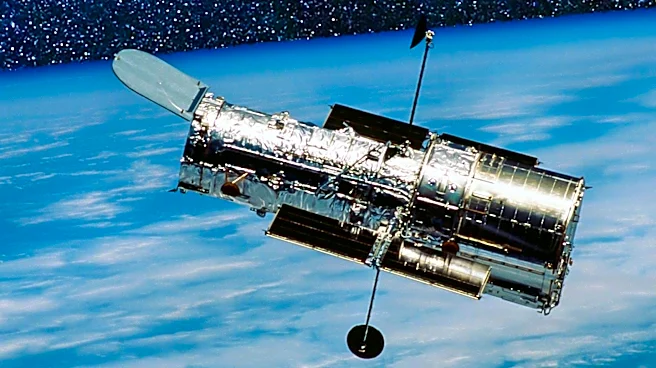
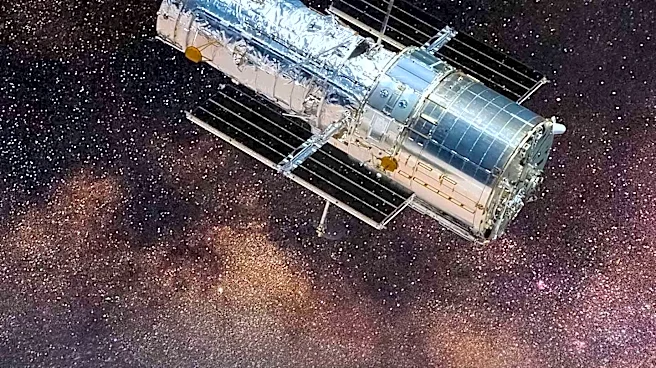
NASA's Hubble Space Telescope has captured a diverse collection of gravitational lenses, which are being used to test theories about dark matter, specifically the cold dark matter theory. Gravitational lensing occurs when the gravity of a massive foreground
object, like a galaxy, bends and magnifies light from a more distant background object. Researchers are using these high-resolution images to detect small imperfections in the lensed galaxy arcs, which could indicate the presence of small clumps of dark matter. The cold dark matter theory predicts the existence of many such clumps, ranging from a million to a billion solar masses. By studying the distortion of these lensed galaxies, astronomers can determine the quantity and distribution of mass in the foreground galaxy, including its invisible dark matter. These observations are also laying the groundwork for follow-up studies by the new Nancy Grace Roman Space Telescope, which launched in August 2026, and will help in building an AI tool for efficient lens searching in future Roman images.
Why It's Important?
The ability to detect and study these small dark matter clumps is crucial for either confirming or challenging the prevailing cold dark matter theory. Dark matter constitutes approximately 25% of the universe, yet its nature remains one of the most significant mysteries in modern physics. Understanding its distribution and properties is fundamental to our comprehension of the universe's structure and evolution. If the predicted dark matter clumps are found, it would provide strong evidence supporting the cold dark matter model. Conversely, a lack of such clumps could necessitate revisions to current cosmological models. The collaboration between Hubble and the Roman Space Telescope, along with the development of AI tools for analysis, signifies a significant advancement in astronomical research, enabling a more comprehensive and efficient exploration of the cosmos and its enigmatic components.
What's Next?
Astronomers will continue to analyze the Hubble images to construct detailed lens models and search for the predicted small clumps of dark matter. The insights gained from Hubble's high-resolution data will be instrumental in developing an AI tool designed to efficiently identify similar gravitational lenses in the wider-field surveys conducted by the Roman Space Telescope. This will significantly expand the sample size of lenses available for study, allowing for more robust testing of dark matter theories and galaxy evolution models. Future observations by the Roman Space Telescope will build upon Hubble's findings, providing a broader panoramic view of the universe and potentially uncovering even more gravitational lenses, further refining our understanding of dark matter and its role in cosmic phenomena.
Beyond the Headlines
The ongoing research into dark matter through gravitational lensing has profound implications for our understanding of fundamental physics and the universe's composition. The existence and properties of dark matter are central to the standard cosmological model, and any findings that either strongly support or contradict current theories could lead to significant paradigm shifts in astrophysics. This research also highlights the power of collaborative efforts between different space observatories and the increasing role of artificial intelligence in processing vast amounts of astronomical data. The ability to 'see' the invisible gravitational effects of dark matter through these cosmic magnifying glasses pushes the boundaries of observational astronomy and offers a unique window into the unseen forces shaping our universe.