







What's Happening?
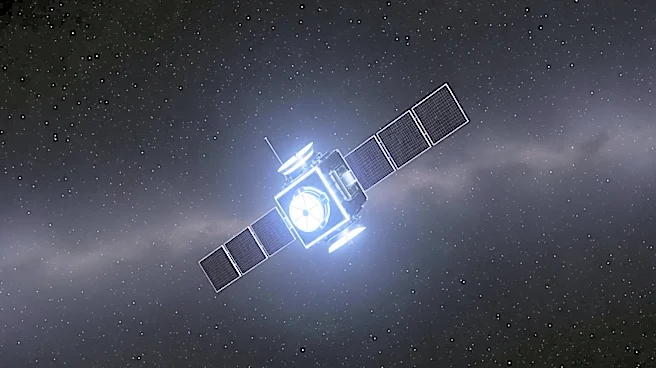
In September 2003, NASA intentionally directed the Galileo spacecraft into Jupiter, ending its 14-year mission. The decision was made to prevent the spacecraft from potentially contaminating Europa, one of Jupiter's moons, which Galileo had discovered
might harbor a subsurface ocean. The spacecraft had survived numerous challenges, including a jammed antenna and intense radiation, and had provided significant scientific insights, such as evidence of a salt-water ocean beneath Europa's icy surface. This discovery made Europa a prime candidate for extraterrestrial life, necessitating the protection of its environment from Earthly microbes that could be carried by the spacecraft.
Why It's Important?
The destruction of Galileo underscores the importance of planetary protection in space exploration. By preventing potential contamination of Europa, NASA preserved the integrity of future scientific investigations into the possibility of life beyond Earth. This action highlights the ethical responsibility of space agencies to avoid interfering with potentially habitable environments. The mission's success in identifying Europa as a candidate for life has significant implications for astrobiology and the search for extraterrestrial life, influencing future missions and international policies on space exploration.
What's Next?
NASA's approach to planetary protection continues to influence current and future missions. The Europa Clipper mission, set to arrive around 2030, is designed to study Europa without landing, minimizing the risk of contamination. Similarly, the European Space Agency's JUICE mission aims to explore Jupiter's icy moons with caution. These missions reflect a growing emphasis on safeguarding celestial bodies that may harbor life, ensuring that scientific discoveries do not compromise the environments being studied.
Beyond the Headlines
The Galileo mission set a precedent for how space agencies handle the discovery of potentially habitable worlds. The ethical considerations of planetary protection are now integral to mission planning, balancing the pursuit of knowledge with the responsibility to preserve extraterrestrial environments. This approach may lead to stricter regulations and innovative technologies to prevent contamination, shaping the future of space exploration and our understanding of life in the universe.