





What's Happening?
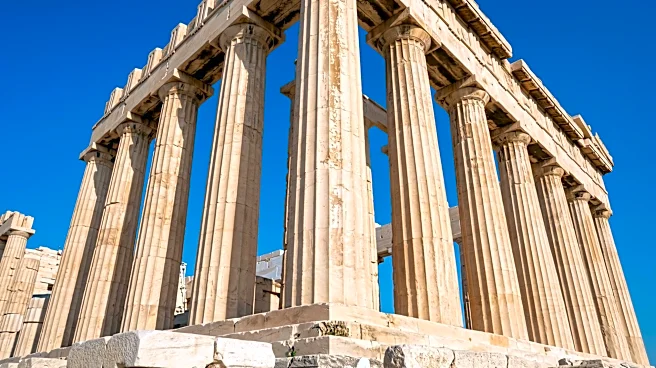
A British mathematician, Alain Goriely from the University of Oxford, has published a study titled 'The Illusion of Illusions: There are no optical corrections in the Parthenon,' challenging the long-held belief that the subtle curves and adjustments
in the Parthenon were designed as optical corrections. For over 2000 years, experts have admired the Parthenon, attributing its architectural genius to the deliberate use of geometry to counteract optical illusions that would otherwise distort its lines. Goriely's research, which involved detailed analysis and mathematical modeling, concludes that these supposed optical corrections are either nonsensical or practically imperceptible. He argues that the 'illusions' themselves are merely illusions. The myth's origin is traced back to the Roman architect and engineer Vitruvius, who wrote about the Parthenon 400 years after its construction. Vitruvius's writings were subsequently published in architectural books, eventually becoming an established fact. Goriely suggests this might be one of the oldest myths, aside from religion.
Why It's Important?
This study significantly impacts the understanding of ancient Greek architecture and its historical interpretation. For centuries, the Parthenon has been lauded as a masterpiece of optical engineering, with its subtle curvatures believed to correct visual distortions. Goriely's findings suggest that this foundational aspect of its architectural praise may be unfounded. This re-evaluation could lead to a shift in how architectural historians and classicists interpret not only the Parthenon but also other ancient structures where similar 'optical corrections' have been assumed. It challenges the narrative of ancient Greek architects as masters of illusion correction, potentially redirecting focus to other motivations for their design choices, such as structural integrity or aesthetic preferences. The study also highlights the enduring power of historical narratives, even those based on potentially flawed interpretations, and the importance of rigorous scientific re-examination of long-accepted facts.
What's Next?
The findings are likely to spark considerable debate within the fields of architectural history, classical studies, and mathematics. Academics and researchers may undertake further investigations to either corroborate or refute Goriely's conclusions. This could involve new measurements, advanced simulations, or re-examinations of historical texts and archaeological evidence. The study's publication in the journal Royal Society Open Science will ensure its visibility within the scientific community, prompting scholarly discussion and potentially influencing future educational curricula regarding ancient Greek architecture. Furthermore, the challenge to a 2000-year-old myth might encourage a broader critical review of other long-standing historical interpretations across various disciplines, urging scholars to 'trust their own eyes' and question established narratives.
Beyond the Headlines
Beyond the immediate architectural implications, Goriely's research touches upon the broader themes of historical interpretation, the persistence of myths, and the interplay between art and science. The fact that a belief originating from a Roman architect writing centuries after the Parthenon's construction became an undisputed truth for millennia underscores how narratives, once established, can become deeply entrenched, even without robust empirical evidence. This phenomenon is not unique to ancient architecture but is observable in many areas of human knowledge. The study implicitly questions the uncritical acceptance of historical accounts and emphasizes the value of scientific inquiry in challenging even the most revered traditions. It also suggests that the aesthetic choices of ancient builders might have been driven by factors other than purely optical corrections, such as structural stability (e.g., preventing water pooling) or a desire for more 'organic' and visually pleasing forms, inviting a more nuanced understanding of their artistic and engineering motivations.