



What's Happening?
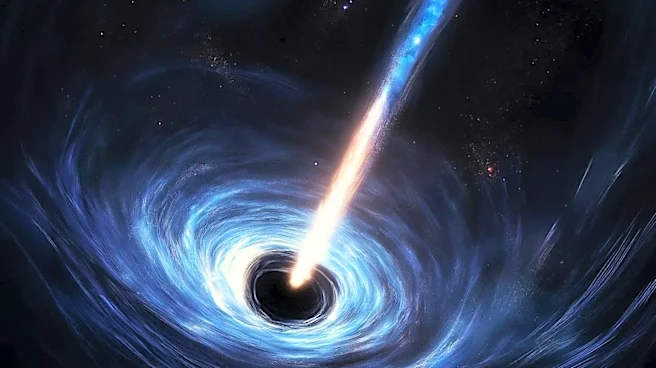
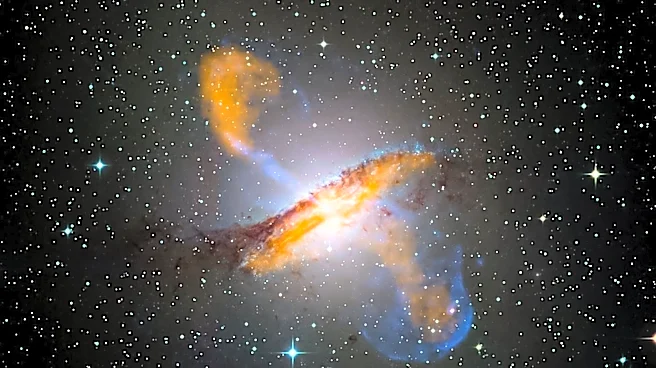
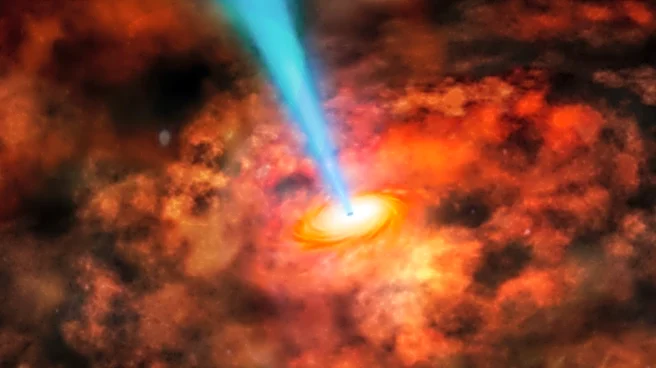
Astronomers have observed a mysterious V-shaped feature, named C4, in the galaxy Centaurus A, approximately 12 million light-years from Earth. This structure is caused by a powerful jet of high-energy particles, moving at nearly the speed of light, emanating
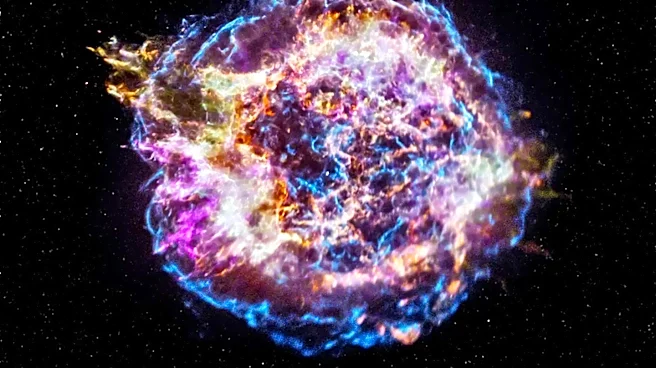
from the supermassive black hole at the galaxy's center. The jet is impacting an unknown object, creating the distinct V-shape. The observation was made using the Chandra X-ray Observatory, which detected low-energy X-rays in pink, medium-energy X-rays in purple, and high-energy X-rays in blue. While black holes are known to produce jets as they accrete matter, this specific V-shaped structure had not been seen before. The arms of the 'V' are estimated to be at least 700 light-years long, and the nature of the object causing this impact remains unidentified, despite extensive study of Centaurus A's black hole and its jet.
Why It's Important?
This discovery is significant for astrophysics and our understanding of black hole dynamics and their interactions with their galactic environments. The unidentified object causing the V-shape presents a unique puzzle, challenging current models of black hole jet behavior and interstellar medium interactions. Understanding what this object is could provide new insights into the composition and distribution of matter in galactic centers, as well as the mechanisms by which black hole jets transfer energy into their surroundings. The unusual V-shape, distinct from the typical 'blobs' formed by jet impacts, suggests a novel type of interaction or an object with previously unobserved properties. This could lead to a re-evaluation of how supermassive black holes influence galaxy evolution and the formation of structures within them. The inability to identify the object with current powerful telescopes highlights the limitations of existing observational capabilities and theoretical frameworks in certain extreme cosmic phenomena.
What's Next?
Astronomers will likely continue to study the C4 structure in Centaurus A using various observational techniques and instruments to gather more data. Future research will focus on attempting to identify the mysterious object causing the V-shape, potentially through different wavelengths of light or advanced imaging technologies. Theoretical astrophysicists will also work to develop new models that can explain the formation of such a distinct V-shape and the nature of the interaction between the black hole jet and the unknown object. This could involve exploring possibilities such as massive stars, binary star systems, or other dense cosmic structures. The findings may also guide the development of next-generation telescopes with enhanced resolution and sensitivity, capable of probing such distant and enigmatic phenomena in greater detail.
Beyond the Headlines
The discovery of the C4 structure and the unidentified object it interacts with touches upon fundamental questions about the universe's composition and the limits of our current scientific understanding. It underscores the vastness of cosmic phenomena that remain unexplained and the continuous evolution of our knowledge through observation and theoretical refinement. The mystery surrounding C4 highlights the dynamic and often violent processes occurring in galactic centers, where supermassive black holes play a crucial role in shaping their host galaxies. This ongoing quest for understanding not only expands our scientific horizons but also inspires public interest in space exploration and the mysteries of the cosmos, reinforcing the importance of continued investment in astronomical research and technology.