





What's Happening?
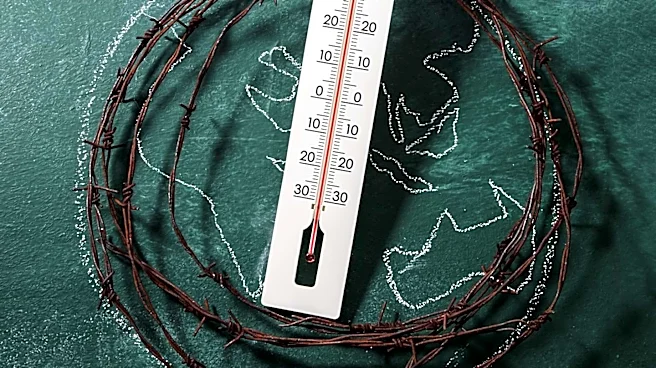
A new study published in Environmental Research Letters reveals that natural systems could amplify global warming by 20 to 30% over the 21st century, a factor largely missing from current climate models and policy decisions. The United Nations Environment Programme
(UNEP) warns that the planet is on track to exceed the critical 1.5°C global warming threshold in the coming years, leading to increased risks such as deadly heatwaves, floods, and crop failures. While human activities like deforestation and greenhouse gas emissions are the primary drivers of climate change, this research highlights the significant, often overlooked, contribution of naturally induced greenhouse gas emissions triggered by warming itself. Examples include increased wildfires, thawing permafrost releasing ancient carbon, and warming wetlands and lakes emitting more methane. These natural feedback loops are already occurring and are expected to become more significant as global temperatures rise.
Why It's Important?
This discovery is crucial because it suggests that current climate projections and policy decisions may be underestimating future warming and overestimating the amount of carbon the world can still afford to emit. The study quantifies the combined impact of these feedback emissions, indicating that even with ambitious climate action and achieving 'net zero' human emissions, these natural feedbacks could add approximately 0.2°C (0.36°F) of warming by 2100. If emissions remain high, this figure could double to 0.4°C (0.72°F). Thawing permafrost alone is responsible for about half of these additional emissions. This means that the timeline for reaching critical warming thresholds is significantly shorter than previously thought, making rapid reduction of fossil fuel-related emissions even more urgent. The findings underscore the interconnectedness of the climate system and the potential for self-reinforcing warming cycles.
What's Next?
The research emphasizes the immediate need for more aggressive climate action to reduce human-caused greenhouse gas emissions. Lowering direct emissions will not only reduce immediate warming but also mitigate the 'hidden multiplier' effect of natural feedback loops. Policymakers and climate scientists will need to integrate these findings into future climate models and policy frameworks to develop more accurate projections and effective mitigation strategies. The study suggests that every effort to cut greenhouse gases will have a dual benefit, reducing both direct warming and the amplification from natural systems. This calls for a re-evaluation of current climate targets and a heightened sense of urgency in implementing solutions, from personal habits to supporting strong climate policies and engaging with elected officials.
Beyond the Headlines
The revelation of this 'hidden multiplier' introduces a new layer of complexity to the climate crisis, highlighting the ethical and long-term implications of delayed action. The concept of natural systems amplifying warming raises questions about the irreversibility of certain climate changes once tipping points are reached. It underscores the idea that the climate system is not merely a passive recipient of human impact but an active participant with its own feedback mechanisms. This understanding could shift the narrative from solely focusing on human emissions to a more holistic view that includes the planet's own responses to warming. The potential for a significantly shorter timeline to critical warming thresholds could trigger a re-evaluation of global economic and social priorities, emphasizing resilience and adaptation alongside mitigation efforts. It also highlights the importance of continuous scientific research to uncover and quantify such complex interactions within the climate system.