



What's Happening?
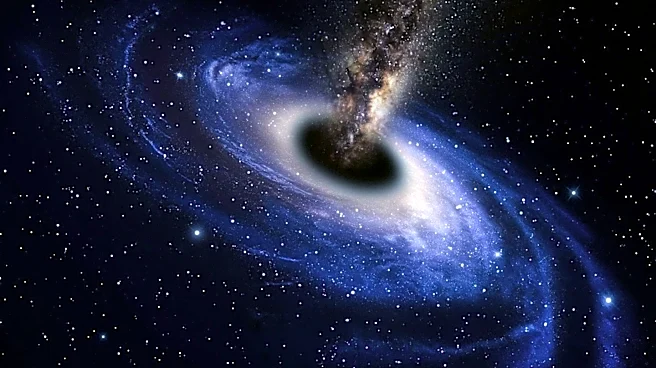
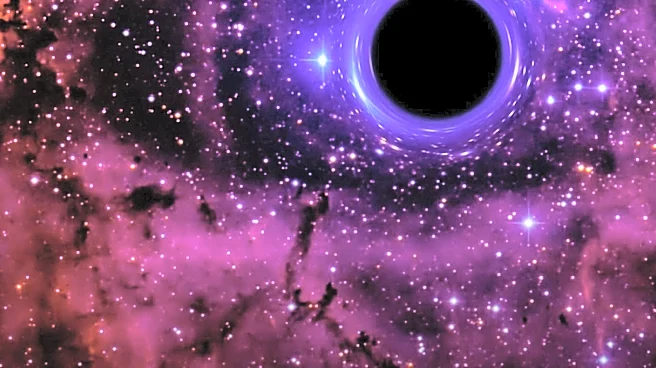
A recent theoretical study published in Physical Review D explores the conditions under which a black hole, typically resistant to splitting, could divide into two. The research, co-authored by Francesco Sannino of the University of Naples Federico II
and the Quantum Field Theory Center at the University of Southern Denmark, along with Giacomo Cacciapaglia, Manuel Del Piano, and Vania Vellucci, suggests that black holes spinning at nearly their maximum possible rate might be an exception to the thermodynamic rules that usually prevent such an event. For a split to occur, the resulting black holes would also need to possess sufficient energy and momentum to move apart, preventing them from collapsing back together. If such a split were to happen, the black hole's event horizon would transform into a 'pair-of-pants' topology, where one region divides into two distinct 'legs'. The study also considers more exotic scenarios, such as those involving additional spatial dimensions, where black-hole-like objects could become unstable and break apart, potentially making a split thermodynamically allowed if one resulting black hole is significantly smaller than the other.
Why It's Important?
This theoretical investigation challenges and expands our understanding of general relativity and the fundamental physics governing black holes. The concept of a black hole splitting, particularly under extreme rotational conditions, pushes the boundaries of current astrophysical models. Traditionally, the second law of thermodynamics dictates that a black hole splitting into two smaller ones would decrease total entropy, making the process thermodynamically unfavorable. However, the study's findings suggest that extreme spin could create a narrow window where this is possible, implying that our understanding of black hole thermodynamics might need refinement under specific, high-energy conditions. This research could lead to new avenues for theoretical physics, prompting further exploration into the behavior of black holes in extreme environments and potentially influencing future observational strategies for detecting such phenomena, even if indirectly through signals from tiny black-hole fragments.
What's Next?
The researchers are working to quantify the probability of a black hole splitting, acknowledging that it depends on how gravity operates beyond Einstein's theory. They anticipate that smaller primordial black holes might be more prone to splitting than larger astrophysical black holes. Future steps involve refining these theoretical models and exploring potential observational methods. Telescopes like Fermi-LAT could be utilized to search for indirect signals from tiny black-hole fragments that might form during merger events, providing empirical evidence to support or refute these theoretical predictions. The study's authors also suggest that further research into theories with additional spatial dimensions could reveal more about the conditions under which black-hole-like objects might become unstable and break apart, potentially leading to a more comprehensive understanding of black hole fragmentation.
Beyond the Headlines
The theoretical possibility of a black hole splitting, particularly under extreme conditions, delves into the very fabric of spacetime and the limits of known physics. It highlights the ongoing quest to reconcile general relativity with quantum mechanics, as the behavior of black holes at their event horizons and under immense gravitational stress often presents paradoxes that current theories struggle to fully explain. The 'pair-of-pants' topology concept, while highly theoretical, offers a vivid mental image of how spacetime itself might reconfigure under such extreme events. This research underscores the dynamic and often counter-intuitive nature of cosmic phenomena, reminding us that our understanding of the universe is constantly evolving. It also opens philosophical questions about the fundamental nature of existence and the ultimate fate of matter and energy within the most extreme gravitational environments.