








What's Happening?
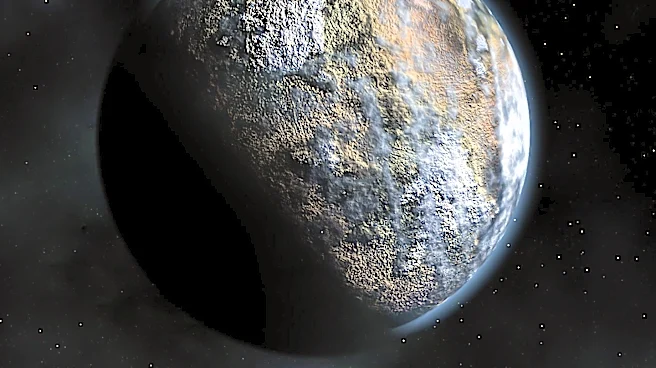
Astronomers have identified a planet named GJ 3378b, located 25 light-years away, as a potentially habitable super-Earth. Initially discovered in 2024 as a sub-Neptune, recent analysis by a team led by Paul Robertson from the University of California,
Irvine, has reclassified it as a rocky super-Earth. This planet orbits a red dwarf star in the constellation Camelopardalis and is situated within the habitable zone, where conditions might allow for liquid water on its surface. The planet's mass is estimated to be 2.3 times that of Earth, and it completes an orbit around its star every 21 days. Despite its promising location, the planet's atmosphere remains uncertain due to the volatile nature of its host star, which could strip away atmospheric layers over time.
Why It's Important?
The discovery of GJ 3378b as a potentially habitable super-Earth is significant for the search for extraterrestrial life. Its proximity to Earth makes it a prime candidate for further study, as it receives about 90% of the starlight Earth gets from the Sun. This discovery highlights the potential for finding life-supporting conditions beyond our solar system. However, the planet's atmosphere is at risk due to the red dwarf's flares and stellar winds, which could erode it over time. Understanding whether GJ 3378b retains an atmosphere is crucial for assessing its habitability and the possibility of biosignatures.
What's Next?
Further investigation into GJ 3378b's atmosphere will require advanced technology, such as NASA's planned Habitable Worlds Observatory, which is not expected to launch until the 2040s. This telescope will be capable of direct imaging, which is necessary since GJ 3378b does not transit its star from our viewpoint. The outcome of these studies could provide insights into the planet's potential to support life and contribute to mapping habitable zones in nearby star systems.
Beyond the Headlines
The reclassification of GJ 3378b from a sub-Neptune to a super-Earth underscores the evolving nature of astronomical discoveries. Initial findings often serve as placeholders until more precise data is available. This case illustrates the importance of continued observation and analysis in the field of exoplanet research, as small changes in data interpretation can significantly alter our understanding of a planet's characteristics and potential for habitability.