




What's Happening?
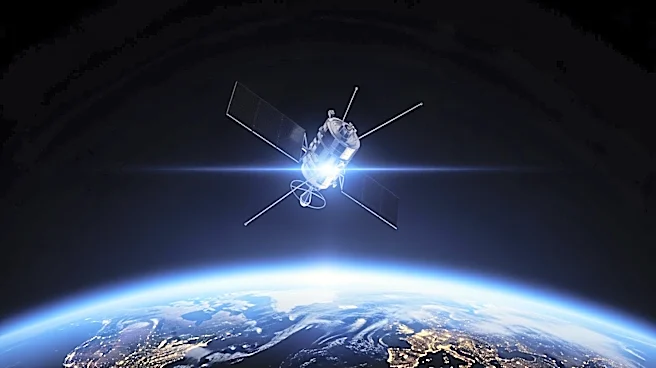
NASA's twin Voyager spacecraft, launched in 1977, are facing significant power challenges as they continue their mission in interstellar space. Originally designed to explore the giant planets, the probes have exceeded their expected lifespans and are now
operating with significantly reduced power. Each spacecraft, which initially generated 470 watts of energy, now has access to only a fraction of that power. To extend their operational life, NASA's Jet Propulsion Laboratory (JPL) plans to implement a maneuver known as the 'Big Bang.' This involves turning off certain devices to save power and potentially delay the shutdown of scientific instruments by at least a year. The maneuver will first be tested on Voyager 2, with plans to apply it to Voyager 1 later. Despite these efforts, the probes lose about four watts of power annually, and their future remains uncertain.
Why It's Important?
The continued operation of the Voyager spacecraft is significant for scientific research and exploration. These probes have provided invaluable data about the outer planets and interstellar space, contributing to our understanding of the solar system and beyond. Extending their operational life allows scientists to gather more data, potentially leading to new discoveries. The mission also highlights the challenges of long-term space exploration, particularly in managing limited resources like power. The success of the 'Big Bang' maneuver could set a precedent for future missions, demonstrating innovative ways to extend the life of space equipment. However, the dwindling power supply underscores the need for advancements in space technology to support prolonged missions.
What's Next?
If the 'Big Bang' maneuver is successful on Voyager 2, it will be implemented on Voyager 1, potentially extending the operational life of both spacecraft. The mission team aims to keep the probes functioning until at least their 50th anniversary in 2027, with hopes of reaching 200 astronomical units from Earth by 2035. This goal depends on the success of power-saving strategies and the continued functionality of the spacecraft's instruments. The outcome of these efforts will be closely monitored by the scientific community, as it could influence future deep-space missions and the development of new technologies to overcome similar challenges.