
What's Happening?
Treasury Secretary Scott Bessent has defended the Trump administration's decision to impose tariffs on eight European countries that oppose President Trump's ambitions to acquire Greenland. In an interview
on NBC News' 'Meet the Press,' Bessent stated that the tariffs are justified as a strategic move to prevent a national emergency. The tariffs, set at 10% and potentially increasing to 25% by June 1, target imports from Denmark, Norway, Sweden, France, Germany, the United Kingdom, the Netherlands, and Finland. The administration argues that acquiring Greenland is crucial for U.S. national security, particularly in countering Russian and Chinese influence in the Arctic. The Supreme Court is expected to rule on the legality of these tariffs, which have been imposed under the International Emergency Economic Powers Act (IEEPA).
Why It's Important?
The imposition of tariffs on European countries over the Greenland issue highlights the Trump administration's aggressive use of economic tools to achieve geopolitical goals. This move could strain U.S. relations with key European allies and impact international trade dynamics. The tariffs are part of a broader strategy to assert U.S. influence in the Arctic, a region of growing strategic importance due to its natural resources and geopolitical positioning. The potential Supreme Court ruling on the legality of using IEEPA for such tariffs could set a significant precedent for presidential powers in economic policy. The situation also raises questions about the balance between national security interests and international diplomatic relations.
What's Next?
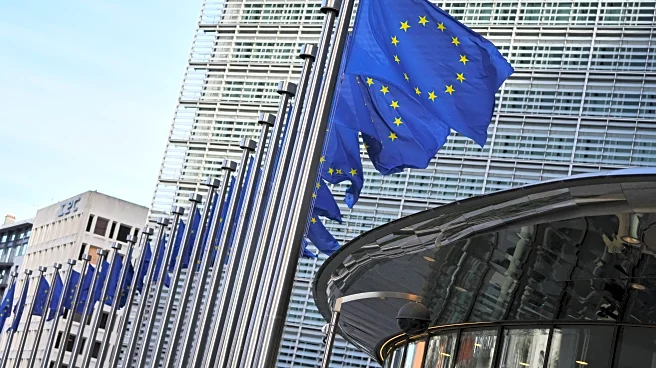
The Supreme Court's upcoming decision on the use of IEEPA to impose tariffs will be closely watched, as it could either affirm or limit the president's authority in economic matters. European Union ambassadors are set to hold an emergency meeting to discuss the U.S. tariffs, indicating potential diplomatic pushback. The outcome of these discussions and the court ruling could influence future U.S. trade policies and international relations. Additionally, the response from European countries and their potential countermeasures could further escalate tensions.