
What's Happening?
A significant collection of artifacts dating from the Ptolemaic to the Byzantine period has been unearthed in the Muharram Bek neighborhood of Alexandria, Egypt. The Egyptian Tourism and Antiquities Ministry
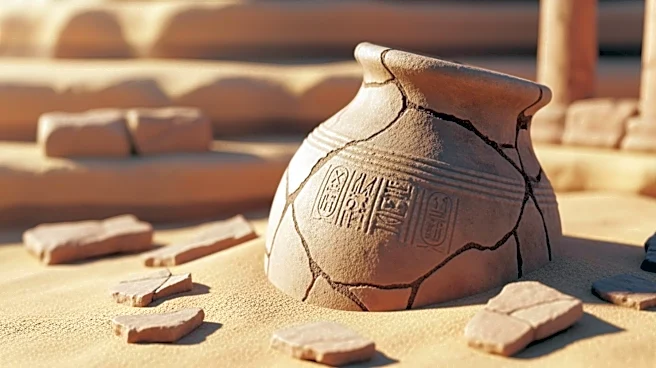
announced the discovery, which includes statues of Greek and Roman deities, coins, lamps, pottery vessels, and amphorae fragments. Among the notable finds are a circular public bath from the Late Ptolemaic era and the remains of a Roman villa with mosaic flooring. These discoveries provide insights into the historical development of Alexandria and its role as a cultural and commercial hub in the ancient world.
Why It's Important?
The discovery of these artifacts is crucial for understanding the historical and cultural evolution of Alexandria, one of the most significant metropolises of the ancient world. The artifacts reflect the city's diverse population and its connections with the Mediterranean region. This find supports efforts to reconstruct the layout of ancient Alexandria, filling important archaeological gaps and enhancing our knowledge of urban development in the area. The artifacts also underscore Alexandria's historical importance as a center of commerce and culture, contributing to the broader understanding of ancient civilizations.