



What's Happening?
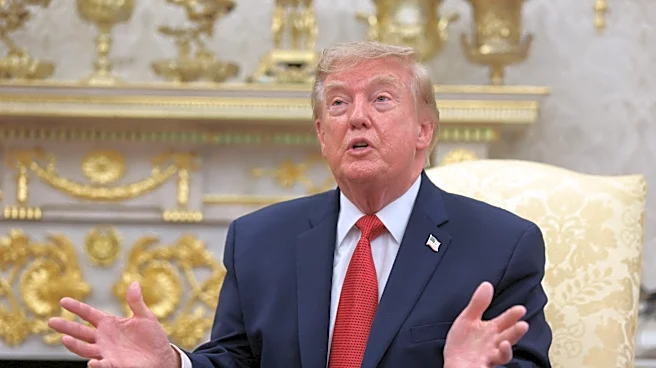
President Trump's job approval ratings have reached historic lows, both nationally and in Arkansas, according to a new statewide survey by Talk Business & Politics and Hendrix College. The poll, conducted August 11-12, 2026, among 1,217 likely Arkansas voters,
shows 53% disapproval of his job performance, with 48% strongly disapproving, compared to 46% who approve. This marks a new low for President Trump in Arkansas. His disapproval ratings are even higher for his handling of the economy (55%) and the war with Iran (56.5%). The poll indicates that the President's low approval is primarily driven by independent voters, with over 70% of this group disapproving of his performance. While Republicans largely remain loyal, there is minor attrition within his own party, with 12% disapproving. The survey also highlights a significant gender gap, with 57% of Arkansas women disapproving, while a slight majority of male voters approve.
Why It's Important?
The significant decline in President Trump's job approval ratings, particularly among independent voters, has critical implications for Republican candidates in the upcoming midterm elections. As noted by Roby Brock, Editor-in-Chief of Talk Business & Politics, and Robert Coon of Impact Management Group, the 'Trump brand' is closely intertwined with the Republican party, and his current unpopularity is exerting 'downward pressure' on GOP candidates across the country and in Arkansas. This suggests that the President's low approval could translate into electoral losses for Republicans, potentially shifting the balance of power in Congress and state legislatures. The strong disapproval among independents, a key demographic in many elections, indicates a broader dissatisfaction that could influence swing districts and states. Furthermore, the particularly low marks for his handling of the economy and the Iran war suggest that these issues are resonating negatively with the electorate, potentially forcing Republican candidates to distance themselves from the President's policies or face voter backlash. The ferocity of disapproval, especially among those who 'strongly disapprove,' indicates a motivated opposition that could drive higher turnout against Republican incumbents.
What's Next?
The immediate consequence of President Trump's low approval ratings will be felt in the upcoming midterm elections. Republican candidates, particularly in competitive races, will need to strategize how to navigate the President's unpopularity. This could involve emphasizing local issues, differentiating themselves from the President, or attempting to mobilize their base despite the broader negative sentiment. The poll results suggest that the President's standing will continue to be a significant factor in the political discourse leading up to the elections. The Democratic Party will likely leverage these disapproval ratings to rally their voters and target vulnerable Republican seats. The specific issues of the economy and the Iran war, where President Trump's approval is lowest, are likely to become central themes in campaign messaging. The long-term implications could include a re-evaluation of the Republican party's reliance on the 'Trump brand' and potentially a shift in party strategy to appeal to a broader base of voters, especially independents and women, who show strong disapproval.
Beyond the Headlines
The consistent decline in President Trump's approval ratings, even in traditionally 'red' states like Arkansas, points to a potential recalibration of voter sentiment that extends beyond partisan lines. The shift among independent voters is particularly noteworthy, suggesting that a segment of the electorate is increasingly prioritizing performance and specific policy outcomes over party loyalty. The strong disapproval regarding the Iran war, despite Arkansas's historical tendency to rally around presidents during conflicts, indicates a critical assessment of the conflict's rationale and execution. This could signal a growing public demand for more transparent and justified foreign policy decisions. The gender gap observed in the poll also highlights persistent challenges for the Republican party in appealing to women voters. This trend, if it continues, could necessitate a broader re-evaluation of party platforms and messaging to address the concerns of this demographic. Ultimately, these poll results reflect a dynamic political environment where the influence of a single political figure, while still significant, is increasingly subject to public scrutiny and evolving voter priorities.