




What's Happening?
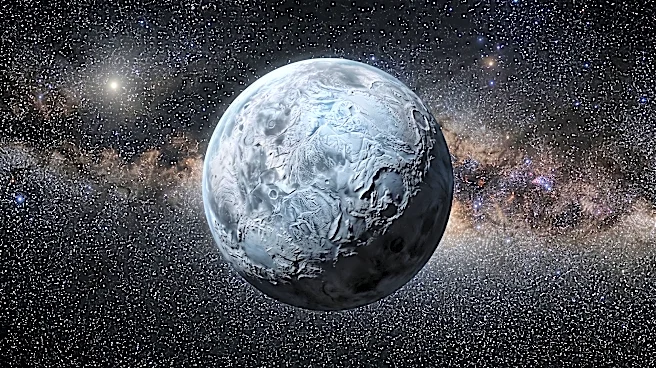
NASA scientists have found compelling evidence of an ancient reservoir of ice in the Kuiper Belt, a distant region of the solar system beyond Neptune. This discovery was made by studying tiny grains of space dust collected high in Earth’s atmosphere by the agency’s
ER-2 high-altitude research aircraft. Researchers at NASA’s Johnson Space Center in Houston, in collaboration with the University of California, Los Angeles (UCLA), analyzed 12 dust particles. High concentrations of solar energetic particle tracks in these particles helped trace their origins to the Kuiper Belt. Using advanced electron microscopy and an ion microprobe, the team identified minerals formed when water interacted with dust early in the solar system’s history. The chemical signatures of these minerals indicate that the ancient water was enriched with heavier oxygen isotopes, providing new insights into the distribution of materials during planet formation.
Why It's Important?
This discovery offers a crucial piece of the puzzle in understanding the formation and evolution of our solar system. The presence of ice with specific isotopic signatures in the Kuiper Belt provides direct evidence for long-held scientific suspicions about the composition of the outer solar system. It helps scientists map how materials were distributed and mixed (or not mixed) across different regions during the early stages of planet formation. The scarcity of similar isotopic signatures in meteorites from the inner solar system suggests that giant planets may have acted as barriers, limiting the mixing of materials between the inner and outer solar system. This research enhances our understanding of planetary science, informing models of how planets, including Earth, acquired their water and other volatile compounds, which are essential for life.
What's Next?
The findings from this study will likely spur further research into the Kuiper Belt and the origins of solar system materials. Scientists will continue to analyze more dust particles and potentially seek new ways to sample materials from this distant region. The data will be integrated into existing models of solar system formation, refining our understanding of protoplanetary disk dynamics and the processes that led to the current arrangement of planets and smaller bodies. Future missions to the outer solar system could be designed to specifically target areas or objects that might contain more of this ancient ice, providing even more detailed information about its composition and distribution. This ongoing research will continue to shape our understanding of cosmic history.
Beyond the Headlines
The study of ancient ice in the Kuiper Belt has profound implications for astrobiology and the search for life beyond Earth. If the early solar system contained distinct reservoirs of water with varying isotopic compositions, it suggests a complex chemical environment that could have influenced the habitability of different planetary bodies. Understanding the origins and distribution of water is fundamental to identifying potentially life-supporting environments. Furthermore, the techniques used to analyze these microscopic dust grains demonstrate the power of advanced analytical methods in unlocking secrets from billions of years ago. This research not only expands our knowledge of our own solar system but also provides a framework for studying exoplanetary systems, helping us to better interpret observations of distant worlds and their potential for harboring water and, by extension, life.