





What's Happening?
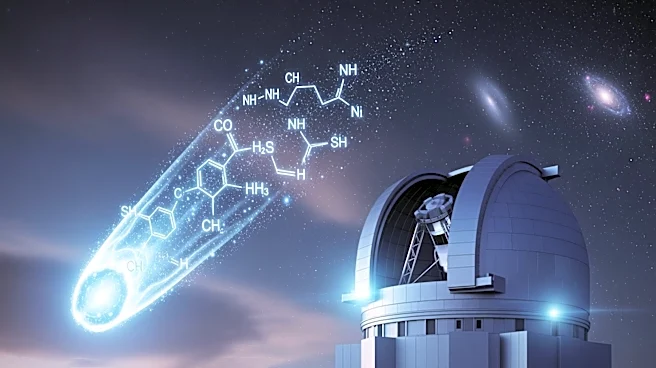
Astronomers have uncovered new insights into the formation of planets and planetesimals through the observation of Interstellar Comet 3I/ATLAS (C/2025 N1). The comet, captured by the Subaru Telescope in December 2025, offers a rare glimpse into the early
stages of planetary formation in distant stellar systems. Published in The Astronomical Journal, the study reveals groundbreaking findings that may reshape our understanding of how planetary bodies form, both within our solar system and beyond. The comet's unique chemical and physical properties provide clues about the early days of planetary formation.
Why It's Important?
The implications of this discovery extend beyond just the study of comets. By understanding the composition of interstellar objects like 3I/ATLAS, scientists hope to build a clearer picture of the processes that lead to the formation of planets in a variety of star systems. This discovery is a testament to the growing body of knowledge about exoplanets, planets that orbit stars outside our solar system, and how they might form in ways similar to Earth. The study's findings could also have implications for the search for life elsewhere in the universe.
What's Next?
As the study continues, researchers will likely focus on further analyzing the chemical composition of 3I/ATLAS to gain deeper insights into the conditions of early planetary systems. The Subaru Telescope's capabilities will continue to be utilized for observing other interstellar objects, potentially leading to more discoveries that could alter our understanding of the universe. The findings may also prompt new research into the potential for life in other star systems, as scientists explore the possibility that the building blocks for life are more common than previously thought.