



What's Happening?
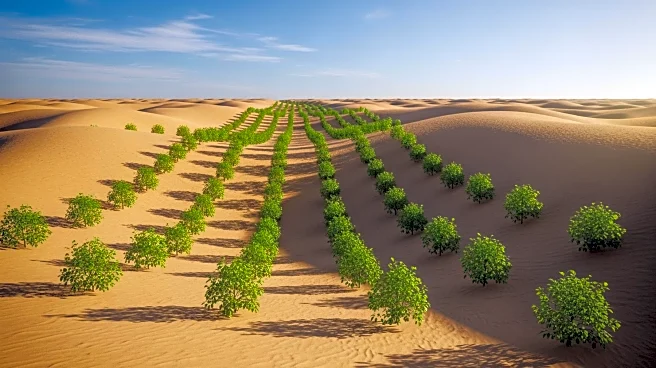
Recent research has revealed that China's extensive tree planting efforts around the Taklamakan Desert have transformed the area into a carbon sink. The Taklamakan Desert, one of the world's largest and driest deserts, has been encircled by vegetation
as part of China's Three-North Shelterbelt Program, also known as the 'Great Green Wall.' This initiative, which began in 1978, aims to combat desertification by planting billions of trees around the desert's edges. The study, published in the journal PNAS, indicates that the vegetation is now absorbing more carbon dioxide than the desert emits, marking a significant environmental achievement. The research utilized ground observations and satellite data to analyze vegetation cover and CO2 fluxes over the past 25 years, showing a trend of increased vegetation and carbon uptake.
Why It's Important?
The transformation of the Taklamakan Desert into a carbon sink has significant implications for global climate change mitigation efforts. By absorbing more carbon dioxide, the desert helps reduce the overall concentration of greenhouse gases in the atmosphere, contributing to the fight against climate change. This initiative demonstrates the potential for human-led interventions to enhance carbon sequestration in arid landscapes, offering a model for other regions facing similar environmental challenges. The success of the Great Green Wall could inspire similar projects worldwide, potentially leading to large-scale environmental benefits and a reduction in desertification.
What's Next?
The continued success of the Great Green Wall project will likely depend on sustained efforts to maintain and expand the vegetation cover around the Taklamakan Desert. Future research may focus on optimizing tree species selection and planting techniques to enhance carbon sequestration further. Additionally, the project could serve as a case study for other countries looking to implement similar environmental initiatives. Monitoring and adapting to climate change impacts will be crucial to ensure the long-term viability of the desert's transformation into a stable carbon sink.