





What's Happening?
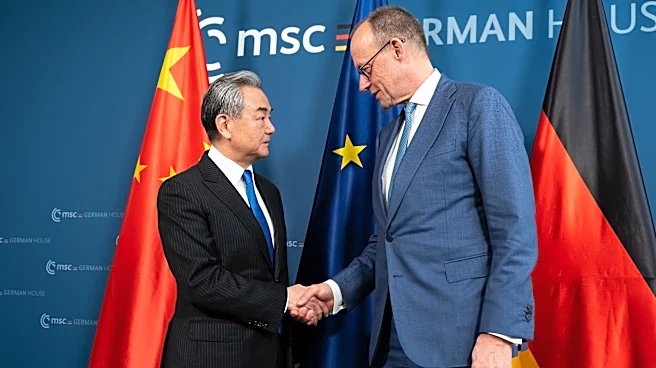
The 37th APEC Ministerial Meeting was held virtually on November 3, 2026, co-chaired by Member of the Political Bureau of the CPC Central Committee and Minister of Foreign Affairs Wang Yi and Minister of Commerce Wang Wentao. The meeting, hosted by China,
focused on the theme of 'Building an Asia-Pacific Community to Prosper Together,' with priorities on openness, innovation, and cooperation. Minister Wang Yi highlighted the Asia-Pacific as a zone of stability, an engine of growth, and a high ground for cooperation amidst a fluid international landscape. President Xi Jinping's vision of promoting economic growth, improving people's lives, and championing open development was reiterated. Minister Wang Wentao stressed the need for 'Asia-Pacific solutions' to address global economic challenges, advocating for free trade, innovation-driven development, and a just international economic and trade order.
Why It's Important?
This APEC Ministerial Meeting is significant for reinforcing regional economic integration and stability in a period of global economic uncertainty. The emphasis on open development and inclusive economic globalization directly addresses concerns about protectionism and fragmentation in industrial and supply chains. For the U.S., a stable and prosperous Asia-Pacific region is crucial for trade, investment, and geopolitical interests. The call for refining the roadmap for a Free Trade Area of the Asia-Pacific and strengthening macroeconomic policy coordination could lead to new trade agreements and reduced barriers, benefiting U.S. businesses operating in or trading with the region. Furthermore, fostering an innovation ecosystem and accelerating digital intelligence transformation aligns with U.S. strategic interests in technological advancement and digital economy growth, potentially creating new opportunities for American tech companies and investors.
What's Next?
The outcomes and consensus reached during the 37th APEC Ministerial Meeting will inform the upcoming APEC Economic Leaders’ Meeting, which is anticipated to be a pivotal event for the future development of the Asia-Pacific. China, as the host, is working with all member economies to ensure fruitful results from the 'APEC China Year.' Future actions will likely include continued efforts to safeguard the multilateral trading system, leverage regional trade arrangements, and build an open Asia-Pacific economy. There will also be a focus on nurturing an innovation ecosystem, accelerating digital intelligence transformation, and broadening cooperation avenues for sustainable development, including green and low-carbon initiatives, and ensuring energy and food security. These discussions and commitments are expected to shape regional policies and economic interactions in the coming years.
Beyond the Headlines
The meeting's focus on building an 'Asia-Pacific community' and promoting 'universally beneficial and inclusive economic globalization' reflects a strategic vision for regional cooperation that extends beyond purely economic considerations. It touches upon deeper themes of mutual respect, solidarity, and coordinated action, which are essential for navigating complex geopolitical dynamics. The emphasis on digital intelligence transformation and innovation highlights the region's commitment to embracing advanced technologies as drivers of growth, potentially setting new standards for digital governance and cross-border data flows. This could lead to increased competition and collaboration in critical tech sectors. The discussions also implicitly address the balance of power and influence within the region, with China playing a central role in shaping the APEC agenda and advocating for its vision of regional integration.