
What's Happening?
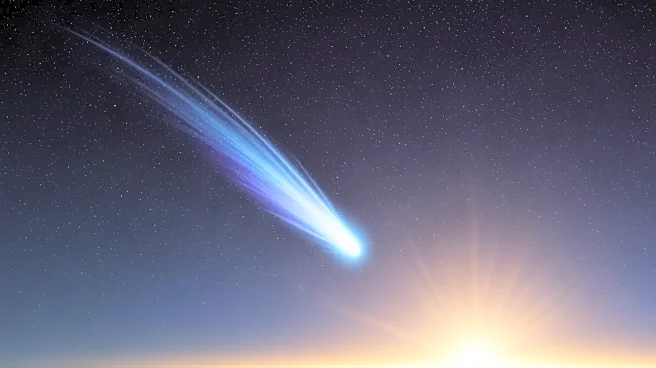
Comet C/2024 E1, also known as Wierzchos, is making its closest approach to the sun today, an event known as perihelion. During this time, the comet will pass approximately 52.6 million miles from the sun, causing it to brighten significantly. This increase
in brightness is due to the sun's heat vaporizing the comet's icy nucleus, releasing gas and dust that form a reflective coma and tail. Although the comet will not be visible to the naked eye, it can be observed with a small telescope. Discovered in March 2024 by the Catalina Sky Survey, the comet is expected to reach a peak brightness of magnitude +8.1, making it visible to observers in the right conditions. After perihelion, the comet will be visible from the Northern Hemisphere in mid-February as it makes a close approach to Earth.
Why It's Important?
The approach of Comet Wierzchos provides a unique opportunity for astronomers and enthusiasts to observe a celestial event that offers insights into the composition and behavior of comets. Such events help scientists understand the early solar system's conditions and the processes that govern cometary dynamics. For amateur astronomers, it presents a chance to engage with astronomy and potentially capture images of the comet. The event also highlights the importance of sky surveys like the Catalina Sky Survey in identifying and tracking near-Earth objects, which are crucial for planetary defense and understanding the solar system's evolution.
What's Next?
Following its perihelion, Comet Wierzchos will continue its journey through the solar system, becoming visible again in the Northern Hemisphere in February. Observers in the U.S. will have the opportunity to view the comet as it passes 93 million miles from Earth. As the comet moves away from the sun, its brightness will decrease, but it will still be a target for telescopic observation. Astronomers will continue to monitor the comet's trajectory and behavior, contributing to ongoing research on cometary science and solar system dynamics.