

What's Happening?
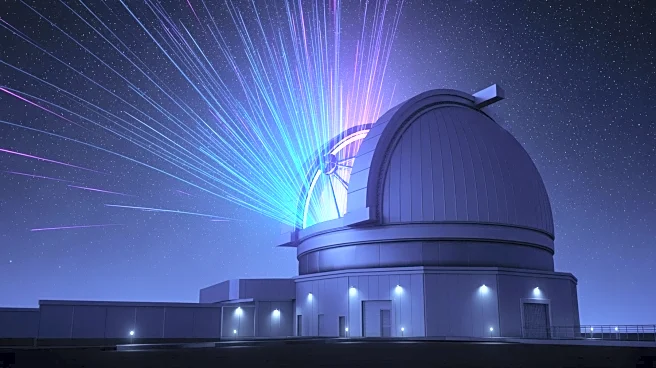
The Vera C. Rubin Observatory, located atop Cerro Pachón mountain in Chile, has achieved a significant milestone by issuing 800,000 astronomy alerts in just one night. This achievement marks the beginning of a new era in astronomical observation, as the observatory
is expected to increase this number to 7 million alerts per night by the end of the year. The alerts are designed to notify scientists of new asteroids, exploding stars, and other changes in the night sky. The observatory's sophisticated software compares new images with template images to detect changes, enabling rapid follow-up by other telescopes. This capability is part of the observatory's preparation for the Legacy Survey of Space and Time (LSST), a 10-year program set to begin later this year.
Why It's Important?
The Vera C. Rubin Observatory's ability to issue a vast number of alerts is poised to transform the field of astronomy. By providing real-time data on cosmic events, the observatory allows scientists to study phenomena such as supernovae, asteroids, and interstellar objects more effectively. This capability enhances the understanding of dark matter, dark energy, and other unknown aspects of the universe. The observatory's alerts facilitate unprecedented collaboration among scientists, enabling them to quickly gather and analyze data. This development is crucial for advancing knowledge in astronomy and could lead to significant discoveries about the universe's fundamental properties.
What's Next?
As the Vera C. Rubin Observatory continues to ramp up its operations, it will begin the LSST program, which aims to image the entire Southern Hemisphere sky every few nights. This program is expected to produce more night-sky images in its first year than all previous optical observatories combined. The observatory's data will generate 10 terabytes of information each night, necessitating advanced image processing and data distribution systems. Scientists worldwide will likely engage in collaborative efforts to analyze this data, potentially leading to groundbreaking discoveries in the field of astronomy.