



What's Happening?
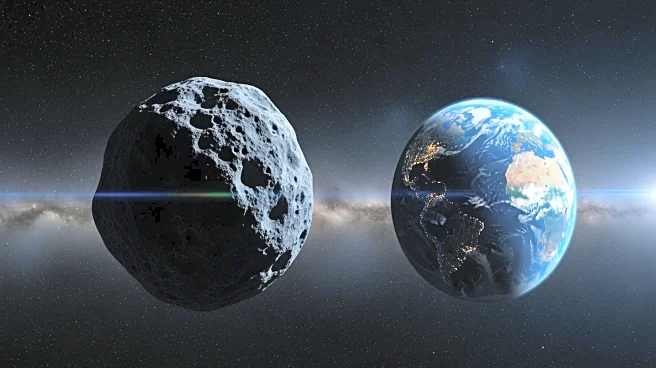
NASA has issued a warning about the presence of over 15,000 asteroids large enough to destroy a city that remain undetected. This revelation was made during a scientific meeting of the American Association for the Advancement of Science (AAAS) in Phoenix,
Arizona. Dr. Kelly Fast, NASA's acting Planetary Defense Officer, highlighted that only about 40% of the estimated 25,000 city-scale asteroids have been catalogued. The remaining asteroids are difficult to detect due to their dark surfaces and positions in the sky that are challenging for telescopes to monitor. The lack of detection poses a significant risk, as a late discovery could lead to a regional catastrophe with little time for response.
Why It's Important?
The undetected asteroids represent a significant threat to global safety, as their potential impact could lead to catastrophic damage in urban areas. The Tunguska event in 1908, where a similar-sized asteroid exploded over Siberia, serves as a historical example of the potential devastation. The inability to detect these asteroids in time could result in a national crisis, emphasizing the need for improved detection and tracking systems. NASA's efforts to develop better detection technologies, such as the Near-Earth Object Surveyor, aim to increase the catalog of known asteroids and provide more warning time for potential impacts.
What's Next?
NASA plans to launch the Near-Earth Object Surveyor, an infrared space telescope, by September 2027 to improve the detection of dark asteroids. This initiative is expected to enhance warning times and allow for more effective deflection strategies. Ground-based telescopes will continue to play a role in monitoring the sky, but space-based systems are crucial for filling observational gaps. International coordination and sustained investment in detection technologies are necessary to mitigate the risks posed by these undetected asteroids.