








What's Happening?
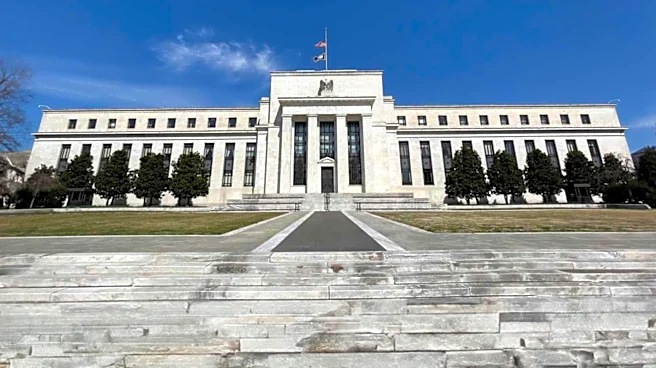
U.S. consumers' expectations regarding unemployment deteriorated in August, according to a survey released by the Federal Reserve Bank of New York. The mean probability that the U.S. unemployment rate will be higher a year from now increased by 1.6 percentage
points, reaching 44.4%. This marks the highest reading for this metric since April 2020. While the perceived likelihood of losing one's job in the next 12 months slightly decreased to 13.8%, the perceived probability of finding a new job after a loss fell by 0.8 percentage points to 45.4%. These sentiments contrast with the surprisingly strong August jobs report from the Bureau of Labor Statistics, which indicated 162,000 new job additions and a steady unemployment rate of 4.1%. Inflation expectations remained largely stable, with median expectations at 3.6% for the one-year horizon and 3% for the five-year horizon.
Why It's Important?
The divergence between consumer sentiment and official jobs data is significant for economic policy and market stability. While the Bureau of Labor Statistics reports a robust labor market, consumers' increasing pessimism about future unemployment and their ability to find new jobs suggests underlying anxieties that could impact spending and investment behaviors. This disconnect might influence the Federal Reserve's decisions on interest rates, as consumer confidence is a key factor in economic stability. If consumers anticipate a weaker job market, they may become more cautious with their finances, potentially leading to a slowdown in economic activity despite positive official statistics. This situation also highlights the challenge for policymakers in communicating economic realities effectively to the public, as perceived economic conditions can be as influential as actual data.
What's Next?
Policymakers and economists will closely monitor future consumer sentiment surveys and labor market data to understand if this divergence is a temporary anomaly or a developing trend. The Federal Reserve may need to address these consumer anxieties in its communications and policy considerations. Businesses might observe a shift in consumer spending patterns if job insecurity perceptions persist, potentially affecting sales and investment plans. Further analysis will be required to determine the root causes of this pessimism, whether it stems from specific sectors, demographic groups, or broader economic uncertainties. The interplay between inflation expectations, labor market outlooks, and credit access will continue to be a critical area of focus for economic stability in the coming months.
Beyond the Headlines
The gap between official economic statistics and public perception can have profound implications for the social fabric and political landscape. When individuals feel less secure about their employment prospects, it can lead to increased social unrest, reduced trust in institutions, and a demand for more interventionist government policies. This situation also underscores the psychological aspect of economics, where fear and uncertainty can become self-fulfilling prophecies, influencing economic outcomes regardless of underlying data. The decline in perceived credit access, coupled with worsening unemployment expectations, could signal a tightening of financial conditions for households, potentially exacerbating economic inequalities. Understanding and addressing these psychological factors is crucial for fostering a resilient economy and a stable society, moving beyond mere statistical reporting to grasp the lived experiences of the populace.