





What's Happening?
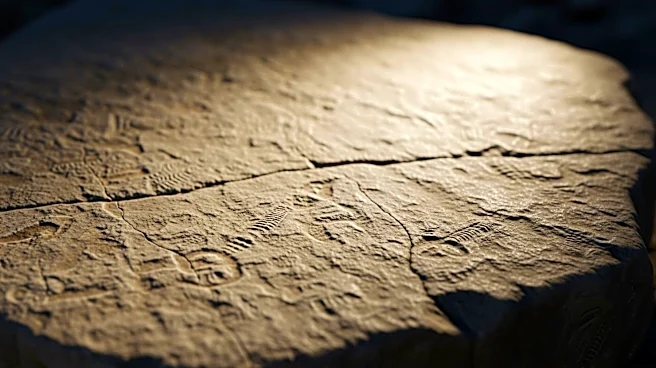
A team of scientists has utilized advanced imaging technology to uncover over 20 microscopic fossils, including a previously unknown species, from a 445-million-year-old black shale rock. This discovery, led by Jonathan Aitchison at the University of Queensland,
Australia, provides new insights into the Late Ordovician period, a time marked by one of Earth's largest mass extinction events. The research involved using synchrotron-based micro-computed tomography to scan the rock, revealing detailed 3D models of radiolarians, microscopic single-celled zooplankton. These findings suggest that similar techniques could unlock a vast archive of ancient life hidden in black shale formations worldwide.
Why It's Important?
The discovery of these fossils is significant as it offers a new method to study ancient marine life and their responses to past climate changes and oxygen loss in oceans. This research could refine models of ecosystem resilience during historical climate warming events, providing valuable data for understanding current and future environmental challenges. The ability to uncover previously inaccessible fossil records may lead to a deeper understanding of how marine ecosystems have historically adapted to significant environmental shifts, potentially informing conservation strategies and climate change mitigation efforts.
What's Next?
The researchers hope to expand their approach to scan longer rock cores and larger numbers of samples, potentially revealing more hidden fossils. This could lead to a broader understanding of ancient marine ecosystems and their responses to environmental changes. The findings may also prompt further studies into the Late Ordovician period and other significant historical climate events, contributing to a more comprehensive understanding of Earth's geological and biological history.