



What's Happening?
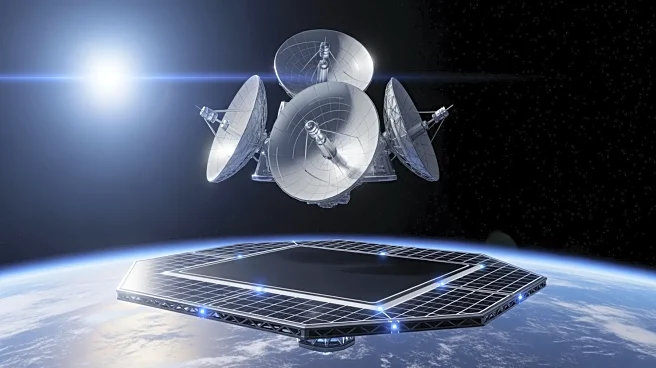
Recent claims circulating on social media suggest that Japan has launched a fully operational space-based solar power system, marking a historic achievement. These claims have been widely shared, often accompanied by futuristic imagery of an orbital solar power station
delivering energy to Earth. However, these assertions misrepresent the current status of Japan's space-based solar power (SBSP) program. Japan is actively researching SBSP, with institutions like Kyoto University and Japan Space Systems developing technologies to collect sunlight in space and transmit it to Earth. Despite successful ground and airborne tests of microwave power transmission, no operational system exists in orbit. The OHISAMA project, a planned satellite test for the mid-2020s, aims to demonstrate the feasibility of such technology but is not intended to provide continuous power.
Why It's Important?
The misleading claims about Japan's SBSP achievements highlight the challenges in accurately communicating scientific progress. While Japan is at the forefront of SBSP research, the technology is still in experimental stages. The potential of SBSP lies in its ability to provide continuous solar energy, unaffected by weather or night, which could revolutionize energy supply. However, significant technical and economic hurdles remain, including high costs and energy conversion inefficiencies. Misrepresentations can lead to public misunderstanding and unrealistic expectations about the timeline and capabilities of emerging technologies.
What's Next?
Japan's next steps involve the OHISAMA project, a small satellite test scheduled for the mid-2020s. This experiment will test the conversion of solar power into microwaves and its transmission to Earth, serving as a proof-of-concept. Success in these tests could pave the way for larger-scale demonstrations and eventual commercial deployment. However, achieving a fully operational SBSP system will require overcoming substantial technical challenges and securing funding for large-scale implementation.
Beyond the Headlines
The broader implications of space-based solar power include potential shifts in global energy dynamics and environmental benefits. If successfully developed, SBSP could provide a sustainable energy source, reducing reliance on fossil fuels and contributing to climate change mitigation. However, ethical and regulatory considerations, such as space debris management and international cooperation, will be crucial in the development and deployment of SBSP systems.