


What's Happening?
Christopher Cowie, an Associate Professor in Philosophy at the University of Durham, has raised concerns about the optimism surrounding the search for extraterrestrial life. Despite the vastness of the universe, Cowie argues that the density of life may
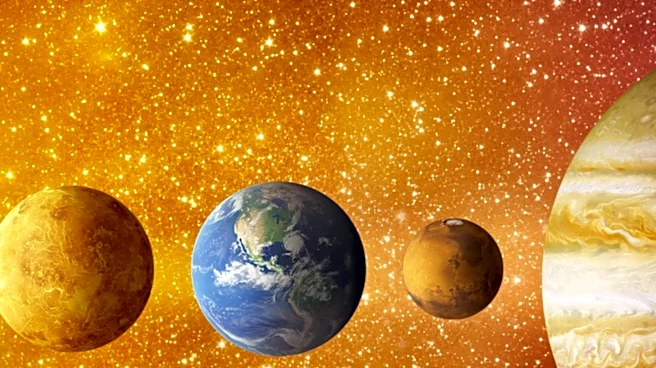
not be sufficient for detection with current technology. The universe's sheer size suggests numerous potential sites for life, such as planets and moons with liquid water. However, Cowie points out that the distances involved make it challenging to gather enough data to confirm the presence of life. He highlights that even with advanced telescopes, the information obtained is often too coarse to confidently hypothesize the existence of life. The optimism, he suggests, is based on the assumption that life is densely distributed, which may not be the case.
Why It's Important?
The discussion around the search for extraterrestrial life has significant implications for scientific research and public interest. If Cowie's skepticism is valid, it could mean that current efforts and investments in space exploration may need to be reevaluated. The potential discovery of life beyond Earth would have profound impacts on our understanding of biology, evolution, and the uniqueness of life on Earth. However, if the search is based on flawed assumptions, it could lead to misallocation of resources and a need to adjust scientific priorities. This debate also influences public perception and expectations regarding space exploration and the potential for finding life beyond our planet.