





What's Happening?
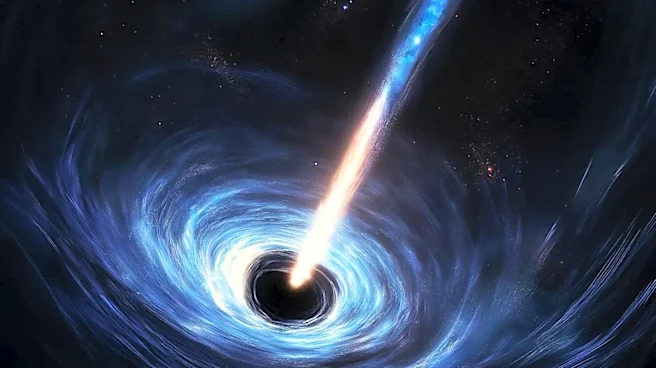
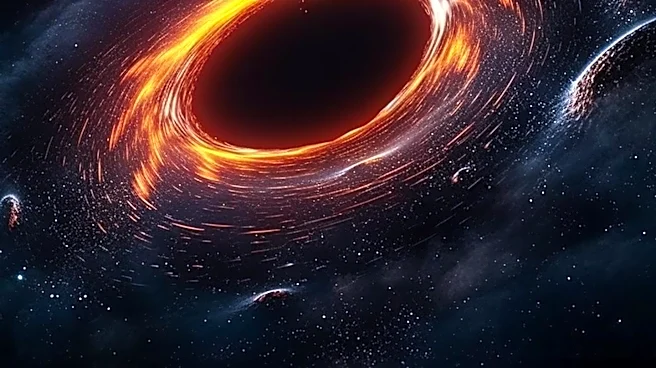
Researchers have identified a mechanism that could explain how supermassive black holes are ejected from galaxies at high speeds. This discovery follows the observation of a thin line in a Hubble Space Telescope image, interpreted as a supermassive black hole leaving
a galaxy. The team, led by Pieter van Dokkum at Yale University, suggests that such events occur when two supermassive black holes merge, creating a new black hole that recoils at supersonic speeds. This phenomenon, though rare, provides insight into the dynamics of black hole mergers and their potential to form runaway black holes.
Why It's Important?
Understanding the dynamics of runaway black holes offers significant insights into galaxy evolution and the behavior of supermassive black holes. These findings could impact our knowledge of cosmic structures and the forces shaping them. The study also highlights the potential for such events to influence the distribution of matter in the universe, affecting theories on galaxy formation and evolution. Additionally, this research could inform future observations and models of black hole behavior, contributing to the broader field of astrophysics.
What's Next?
Further observations and simulations are needed to confirm the runaway black hole hypothesis. The team plans to use their model to predict gravitational waves from such events, which could be detected by upcoming instruments like the Laser Interferometer Space Antenna (LISA). These efforts aim to provide more definitive evidence of runaway black holes and refine our understanding of their origins and impacts. Continued study of these phenomena could lead to breakthroughs in our comprehension of the universe's most extreme environments.