


What's Happening?
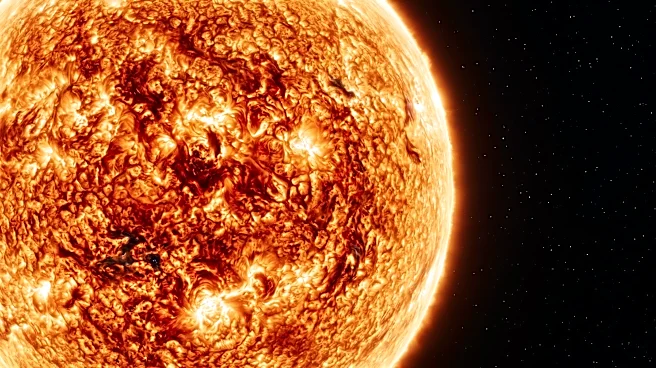
Nuclear fusion in the Sun's core simultaneously releases neutrinos and high-energy photons. Neutrinos, which interact minimally with matter, can travel from the Sun's core to its surface in approximately two seconds and reach Earth in about eight minutes
and twenty seconds. This provides an almost real-time report on the Sun's core activity. In contrast, the energy carried by photons, initially in the form of gamma rays, takes roughly 170,000 years to escape the Sun's dense interior. This immense delay is due to countless scatterings, absorptions, and re-emissions as the energy diffuses through the plasma. The photons themselves do not slow down, but their path is a 'random walk' through the solar material, constantly changing direction and being re-emitted at lower energies until they emerge as visible light from the photosphere.
Why It's Important?
This fundamental difference in how neutrinos and photons escape the Sun is crucial for understanding stellar physics and validating solar models. Neutrinos offer a direct, nearly instantaneous window into the nuclear fusion processes occurring deep within the Sun's core, allowing scientists to study the present-day conditions. This was particularly important in resolving the 'solar neutrino problem,' where early experiments detected fewer electron neutrinos than predicted, leading to the discovery of neutrino oscillation. Conversely, the long journey of photons provides information about the Sun's internal structure and energy transport mechanisms over vast timescales. By comparing these two messengers, astronomers can cross-reference data and refine their models of the Sun's density, temperature, and opacity, ensuring a comprehensive understanding of our star's evolution and energy production. This dual approach enhances the accuracy of astrophysical predictions and our understanding of star formation.
What's Next?
Ongoing research will continue to leverage both neutrino detection and solar observation to refine models of the Sun's interior. Future neutrino observatories with enhanced sensitivity to different neutrino flavors will provide even more precise data on fusion rates and conditions within the core. Advances in helioseismology, which studies the Sun's oscillations, will further complement these observations by providing additional constraints on internal structure. Scientists will continue to develop more sophisticated solar models that integrate these diverse data sets, aiming for a more complete and accurate picture of the Sun's dynamics. This continuous refinement of solar models is essential for understanding not only our own star but also other stars in the universe, contributing to a broader understanding of stellar evolution and the fundamental forces of nature.
Beyond the Headlines
The stark contrast between neutrino and photon escape times highlights a profound aspect of physics: the varying interactions of fundamental particles with matter. Neutrinos, often called 'ghost particles,' demonstrate how weakly interacting particles can traverse immense densities almost unimpeded, offering unique insights into extreme environments like stellar cores. The photon's journey, on the other hand, illustrates the complex interplay of radiation and matter in a plasma, where energy is not carried by a single particle but rather by a continuous process of absorption and re-emission. This concept of energy diffusion through a 'random walk' has implications beyond astrophysics, influencing fields like material science and heat transfer. The ability to study the Sun's core in 'real-time' via neutrinos, while simultaneously observing its surface emission that reflects processes from millennia ago, provides a powerful testament to the multi-messenger astronomy approach, offering a deeper, multi-layered understanding of cosmic phenomena.