
What's Happening?
In a landmark environmental decision, the Federal Energy Regulatory Commission (FERC) ordered the removal of the Edwards Dam on the Kennebec River in Maine on November 25, 1997. This decision, which led
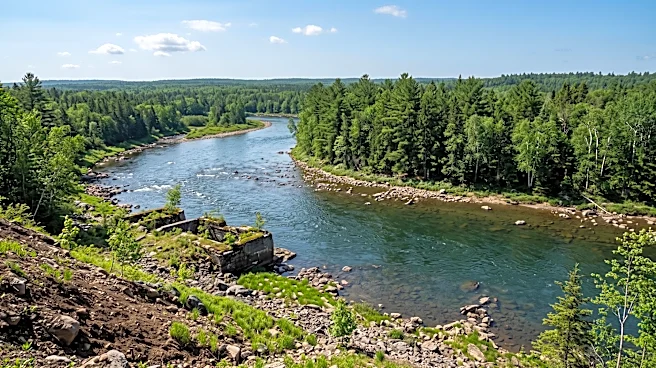
to the dam's demolition on July 1, 1999, marked the first time the U.S. federal government prioritized the benefits of a free-flowing river over those of a hydroelectric power plant. The Edwards Dam, a wooden and concrete structure built in 1837, had blocked the migration of millions of fish for over 150 years. Its removal allowed approximately 27 kilometers of the Kennebec River to flow freely, a condition it had not experienced since its construction. The initial aftermath involved disturbed sediments and bare riverbanks, but this was seen as a prelude to ecological recovery.
Why It's Important?
The FERC's decision to remove the Edwards Dam was a pivotal moment in U.S. environmental policy, establishing a precedent for river restoration projects nationwide. It demonstrated that the ecological benefits of restoring natural river flow could outweigh the industrial and energy production advantages of aging infrastructure. This action directly led to a dramatic ecological rebound, particularly for migratory fish species. Before the dam's removal, the annual upstream migration of alewives in the Kennebec River was non-existent. Today, approximately five million alewives return annually, a figure that was unimaginable in the late 1990s. Other migratory species, such as tasty alewives, striped bass, and sturgeon, have also benefited, with tens of millions of fish now able to access historical spawning grounds. This restored abundance has also positively impacted natural predators, including bald eagles, whose populations have increased significantly in the area.
What's Next?
The success of the Edwards Dam removal has inspired numerous other river restoration initiatives across the United States. According to American Rivers, 1,605 dams have been removed nationwide since the Edwards Dam project, signaling a growing movement towards restoring natural waterways. This precedent continues to influence policy and project development, encouraging the dismantling of other aging and environmentally detrimental dams. For instance, the removal of the Fort Halifax Dam on a Kennebec tributary in 2008, a direct consequence of the Edwards Dam's removal, has allowed an estimated 27 million alewives to reach their historical spawning habitats. This ongoing trend suggests a future where ecological considerations increasingly drive decisions regarding hydraulic infrastructure, potentially leading to more widespread river liberation projects.
Beyond the Headlines
The Edwards Dam removal highlights a deeper shift in societal values regarding environmental conservation versus industrial utility. It challenged the long-held belief that human-made energy infrastructure and natural river ecosystems were irreconcilable, demonstrating that a courageous political choice could trigger a chain reaction of ecological benefits far beyond the initial scope. This case serves as a critical study for evaluating the future of aging hydraulic infrastructure globally, prompting discussions on the long-term ecological and economic costs of dams versus the benefits of their removal. It underscores the ethical dimension of balancing human needs with environmental stewardship and the potential for significant ecological recovery when natural processes are allowed to resume.