





What's Happening?
The New York Center for AI Responsibility and Research at Binghamton University is rapidly advancing its mission to promote AI science and safety. Established with a $30 million philanthropic gift and a $25 million research investment from SUNY, the center
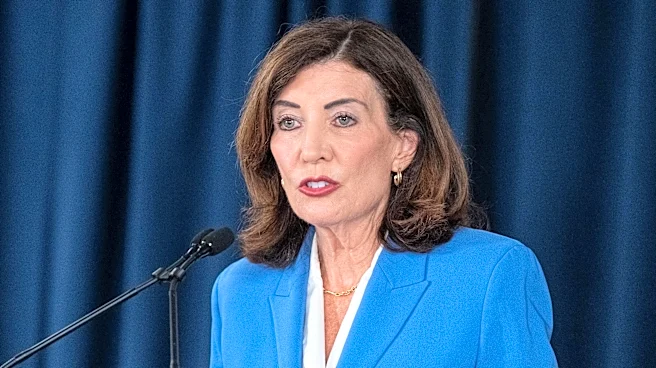
recently received a boost from Governor Kathy Hochul, who appointed Greg Morrisett of Cornell Tech and Jeannette Wing of Columbia University as interim co-directors. These leaders will unite over 80 scientists from various New York institutions specializing in AI safety, security, and computer science. The center is also supported by Empire AI, a $500 million public-private initiative. A recent forum on the Binghamton campus gathered academic, industry, and government leaders to discuss priorities and challenges in AI research, focusing on safety, verification, transparency, and hardware verifiability. Binghamton University President Anne D’Alleva emphasized the center's role in leading the nation in AI transparency and security.
Why It's Important?
This initiative is crucial for New York State to establish itself as a leader in responsible AI development and governance. By bringing together top researchers and securing significant funding, the center aims to address critical societal concerns surrounding AI, such as its impact on education, account security, and overall safety. The focus on independent testing and rigorous scientific inquiry is intended to ensure that increasingly powerful AI systems are reliable and safe for public use. This proactive approach, supported by the state's RAISE Act which mandates safety protocol disclosures and incident reporting for large AI developers, positions New York at the forefront of trustworthy AI. The collaboration between academia, industry, and government is vital for creating a comprehensive framework that balances innovation with ethical considerations, potentially setting a national standard for AI regulation and development.
What's Next?
The immediate next steps for the New York Center for AI Responsibility and Research involve synthesizing the discussions from the recent conference and working with the new co-directors to plan the initial rollout of the center’s efforts. This will likely include establishing specific research agendas, fostering collaborations among the diverse group of scientists, and developing concrete projects related to AI safety, security, and transparency. The center will also play a key role in implementing the state's RAISE Act, which requires AI developers to register with the new Office of Digital Innovation, Governance, Integrity, and Trust (DIGIT) by January 1. Future activities will likely involve ongoing forums, workshops, and publications to disseminate research findings and influence public policy on AI. The center's work is expected to inform a forward-looking roadmap for transformative AI research.
Beyond the Headlines
The establishment and rapid progression of the New York Center for AI Responsibility and Research highlight a growing recognition of the profound ethical and societal implications of artificial intelligence. Beyond technical safety, the center's work touches upon the broader responsibility of academic institutions to act as a counterweight to the profit motives of tech companies, as articulated by Renzi Arpaci-Dusseau. This initiative underscores a shift towards a more proactive and collaborative approach to AI governance, moving beyond simply reacting to technological advancements. The emphasis on 'liquid infrastructure' and the evolving nature of code suggests a need for continuous adaptation in regulatory and safety frameworks. This effort could serve as a model for other states and nations grappling with how to foster AI innovation while safeguarding public interest and ensuring equitable and secure technological development.