







What's Happening?
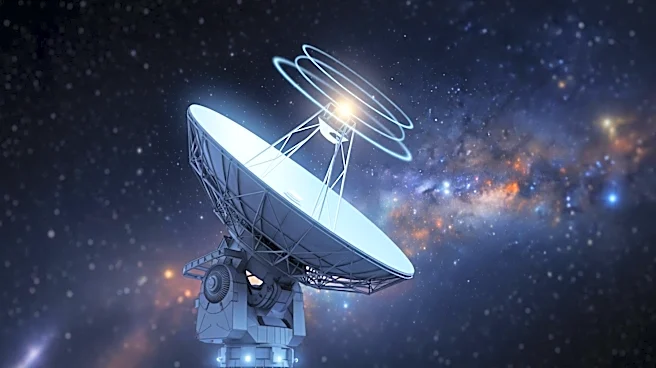
NASA's Deep Space Network (DSN) has successfully acquired the radio frequency signal from the Artemis II mission, marking the first time in over 50 years that the network is communicating with a crewed spacecraft traveling through deep space. The DSN,
operated by NASA's Jet Propulsion Laboratory in Southern California, consists of complexes in Goldstone, California; Madrid, Spain; and Canberra, Australia. These complexes are equipped with radio frequency antennas that facilitate communication with robotic spacecraft exploring the solar system, including the Artemis II mission. The DSN is managed by JPL for NASA's Space Communications and Navigation program, allowing missions to track, send commands to, and receive scientific data from distant spacecraft.
Why It's Important?
The successful communication between the DSN and Artemis II is a significant milestone for NASA, as it demonstrates the capability to support crewed missions beyond Earth's orbit. This achievement is crucial for future deep space exploration missions, including those aimed at Mars and beyond. The DSN's ability to maintain communication with spacecraft in deep space ensures that scientific data can be transmitted back to Earth, aiding in the advancement of space exploration technologies and strategies. This development also highlights the importance of international collaboration, as the DSN's global network of complexes plays a vital role in supporting NASA's missions.