





What's Happening?
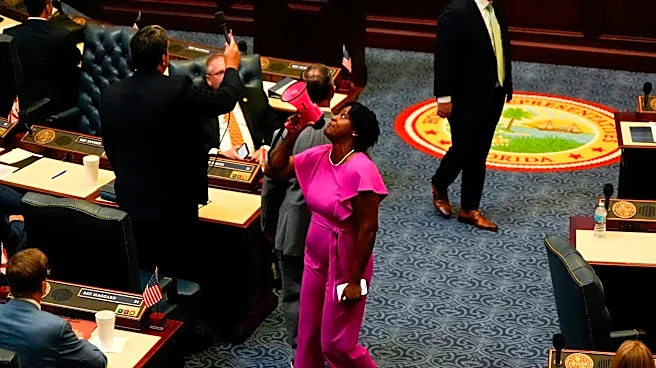
Angie Nixon, the Democratic nominee for U.S. Senate in Florida, has voiced strong criticisms regarding Israeli Prime Minister Benjamin Netanyahu and U.S. military aid to Israel. Following her primary victory, Nixon appeared on Morning Joe, where she referred
to Netanyahu as 'a war criminal who needs to answer to his crimes' and stated her opposition to sending U.S. money or weapons to Israel 'at this moment.' Her stance aligns with the Democratic Socialists of America (DSA), an organization she recently joined, which advocates for Palestinian liberation. Nixon's campaign, while primarily focused on domestic issues like affordability and healthcare, has consistently included her views on the Israeli-Palestinian conflict. She previously introduced a resolution in the Florida House in November 2023 calling for an immediate de-escalation and ceasefire, which was largely rejected. In May 2024, she joined pro-Palestinian protesters at the University of North Florida, expressing support for their cause. Her official foreign policy platform calls for ending unconditional U.S. military aid to Israel, which she claims has 'fueled a genocide in Palestine,' and advocates for a path to Palestinian self-determination through the United Nations Security Council. She also indicated she would have voted for a House amendment to end $3.3 billion in annual U.S. military aid to Israel, an amendment introduced by U.S. Rep. Thomas Massie.
Why It's Important?
Angie Nixon's nomination and her outspoken views on Israel are significant for several reasons. Her victory marks the first time a member of the Democratic Socialists of America has won a major-party nomination for statewide office, indicating a growing influence of progressive and DSA-backed candidates in U.S. politics. This shift could lead to increased pressure within the Democratic Party to re-evaluate U.S. foreign policy, particularly concerning aid to Israel. Her position on cutting military aid to Israel, a long-standing ally, could spark considerable debate and potentially alter the dynamics of U.S.-Israel relations if such views gain broader traction. The Florida Senate race itself, where Nixon faces Republican U.S. Sen. Ashley Moody, will serve as a barometer for how these progressive stances resonate with the broader electorate in a state that has recently trended Republican. Furthermore, her comments on Prime Minister Netanyahu and the use of U.S. aid highlight a growing divide within American political discourse regarding the Israeli-Palestinian conflict, potentially influencing future legislative actions and public opinion on foreign policy matters.
What's Next?
Angie Nixon will face Republican U.S. Sen. Ashley Moody in the November general election. This election will be a key test of how her progressive platform, including her stance on Israel, resonates with Florida voters. Given that Moody is considered a favorite in a state that has shifted Republican, the outcome will indicate the extent to which a candidate with strong anti-Israel aid positions can succeed in a competitive statewide race. Her continued association with the Democratic Socialists of America and their advocacy for Palestinian liberation suggests that these issues will remain central to her political identity and potentially influence her actions if elected. The debate surrounding U.S. military aid to Israel is likely to intensify, with Nixon's candidacy adding a prominent voice to those advocating for its cessation. Her campaign will likely continue to draw attention to the humanitarian situation in Gaza and challenge traditional U.S. foreign policy approaches in the Middle East, potentially inspiring similar movements in other states.
Beyond the Headlines
Angie Nixon's rise reflects a broader ideological shift within parts of the Democratic Party, where younger and more progressive voices are increasingly challenging established foreign policy norms. Her success, even in a challenging state like Florida, could embolden other candidates to adopt similar positions, potentially leading to a more significant re-evaluation of U.S. foreign policy towards Israel. The debate over U.S. aid to Israel also touches upon deeper ethical considerations regarding human rights and international law, particularly in the context of the Israeli-Palestinian conflict. The use of terms like 'genocide' by a political candidate, while controversial, highlights the emotional and moral dimensions of the conflict for many Americans. This trend could lead to a more nuanced and critical public discourse on U.S. involvement in global conflicts, moving beyond traditional bipartisan consensus. Furthermore, the influence of organizations like the Democratic Socialists of America in mainstream politics suggests a potential long-term shift in the Democratic Party's platform, emphasizing social justice and human rights in foreign policy decisions.