








What's Happening?
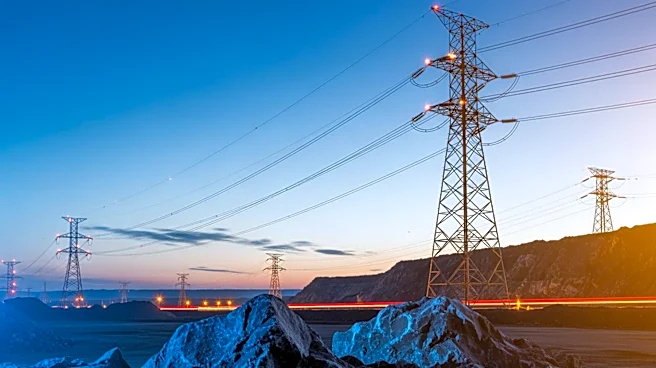
The Democratic Republic of Congo (DRC) is considering acquiring an equity stake in a $270 million cross-border electricity project with Zambia. This initiative aims to address the increasing power shortages that threaten the DRC's copper mining sector,
a critical component of its economy. The project involves a 200-kilometer high-voltage transmission line connecting Kalumbila in Zambia to Kolwezi in the DRC, expected to initially deliver 460 megawatts (MW) with potential expansion to 550 MW. The DRC's mining sector is under pressure due to rising electricity demand, driven by the government's push for local mineral processing. This has led to reliance on costly diesel generators due to limited grid capacity. Finance Minister Doudou Fwamba highlighted that adding 1 gigawatt (GW) of power could potentially double current mining output, emphasizing the importance of energy infrastructure in the country's industrial strategy.
Why It's Important?
The DRC's move to secure a stake in the Zambia power link is crucial for its mining sector, which is a significant contributor to the national economy. The sector's reliance on diesel generators due to insufficient grid capacity increases operational costs and affects profitability. By investing in this power project, the DRC aims to stabilize and potentially increase mining output, aligning with its policy to enhance local processing and retain more value domestically. This development could also attract further private investments in energy infrastructure, as seen with CrossBoundary Energy's solar and battery storage project. The initiative reflects a broader strategy to address the country's severe electricity deficit, which is estimated at over 5,000 MW, and to leverage its untapped hydropower potential.
What's Next?
The DRC's involvement in the Zambia power link project is part of a larger infrastructure push, supported by a recent $1.25 billion eurobond issuance. The construction start date for the transmission line is yet to be confirmed, but the project is expected to significantly alleviate the power shortages in the DRC's mining regions. As the project progresses, it may prompt further investments in energy infrastructure, potentially reducing the sector's reliance on diesel generators. Additionally, the success of this project could serve as a model for future cross-border energy collaborations in Africa, enhancing regional energy security and economic integration.