



What's Happening?
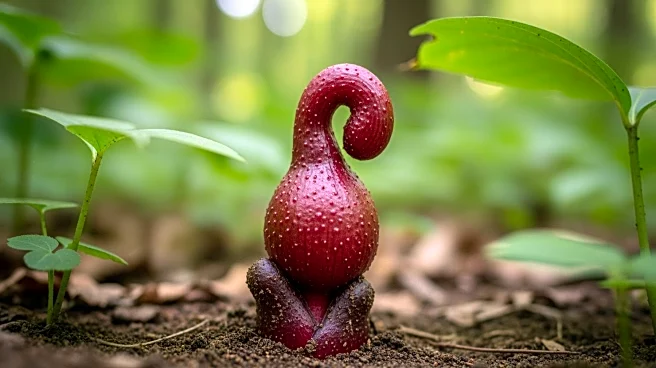
A recent study conducted by a collaborative team from the Okinawa Institute of Science and Technology, Kobe University, and the University of Taipei has unveiled new insights into the Balanophora plant, a rare parasitic species found in the subtropical
forests of East Asia. Unlike typical plants, Balanophora lacks chlorophyll and a conventional root system, relying instead on parasitizing nearby trees for nutrients. The study, published in New Phytologist, explores the plant's evolutionary history and its unique adaptations, such as reduced plastids that still perform essential functions despite the absence of photosynthesis. The research also highlights Balanophora's unusual reproductive strategies, including facultative and obligate agamospermy, which allow it to reproduce without fertilization. This adaptation is particularly advantageous for colonizing isolated island habitats, although it poses risks such as reduced genetic diversity.
Why It's Important?
The findings about Balanophora's adaptations and reproductive strategies are significant for understanding plant evolution and the ecological dynamics of parasitic species. The plant's ability to thrive in specific niches highlights the complexity of parasitic relationships and the evolutionary trade-offs involved. The study underscores the importance of conserving such unique species, as their specialized nature makes them vulnerable to environmental changes and human activities like logging. Understanding Balanophora's biology could inform conservation strategies and provide insights into the evolutionary processes that allow plants to adapt to extreme ecological niches.
What's Next?
Future research may focus on further exploring the genetic and ecological aspects of Balanophora to better understand its survival mechanisms and potential vulnerabilities. Conservation efforts will be crucial to protect the remaining populations, particularly in regions where their habitats are threatened. Collaborative efforts with local authorities and experts in parasitic plants will be essential to ensure the preservation of this unique species. Additionally, the study opens avenues for investigating other parasitic plants and their evolutionary adaptations, which could have broader implications for biodiversity and ecosystem management.
Beyond the Headlines
The study of Balanophora not only sheds light on the plant's unique biology but also raises broader questions about the role of parasitism in evolution and ecology. The plant's reliance on specific host species and its reproductive strategies challenge traditional views of plant reproduction and survival. This research highlights the delicate balance between specialization and vulnerability in evolutionary biology, offering a window into the complex interactions that shape ecosystems. The findings also emphasize the need for interdisciplinary approaches to study and conserve biodiversity in the face of environmental change.