





What's Happening?
Representative Dan Newhouse executed a stock sale of up to $15,000 on July 10. This transaction involved shares of $TMO, a company that has seen significant trading activity from both institutional investors and corporate insiders. According to Quiver
Quantitative's congressional trading dashboard, this sale is one of the few congressional trades involving $TMO stock in the past six months, with only one sale and no purchases reported by members of Congress during this period. The broader context for $TMO includes 94 insider sales and no insider purchases over the last six months, alongside substantial institutional investor activity, with 1,276 institutions adding shares and 1,296 decreasing their positions in the most recent quarter. The WELLCOME TRUST LTD (THE) recently opened a new $270.0M position in $TMO, indicating continued institutional interest despite insider selling.
Why It's Important?
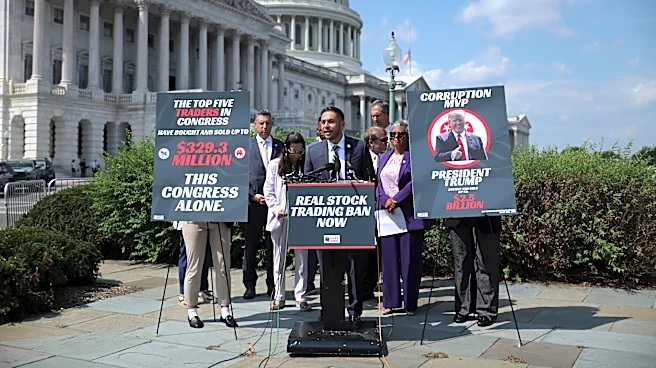
The stock sale by Representative Dan Newhouse highlights the ongoing practice of congressional stock trading, which often draws scrutiny regarding potential conflicts of interest. While the amount of this particular sale is relatively modest, such transactions by lawmakers can raise questions about whether their legislative actions could be influenced by their personal financial interests. For the broader market, the sale of $TMO stock by a member of Congress, coupled with a high volume of insider sales, could be interpreted by some investors as a signal, even if not directly indicative of future performance. Conversely, the significant institutional investment, such as the $270.0M position opened by WELLCOME TRUST LTD, suggests that large financial entities maintain confidence in the company's prospects, creating a mixed signal for individual investors tracking market movements and congressional activity.
What's Next?
The transaction by Representative Newhouse will likely be recorded and publicly available through congressional trading disclosures, contributing to the ongoing data tracked by platforms like Quiver Quantitative. This transparency allows the public and financial analysts to monitor the trading activities of elected officials. In the broader political landscape, discussions around congressional stock trading continue, with some advocating for stricter regulations or outright bans to prevent perceived conflicts of interest. Future legislative sessions may see renewed efforts to introduce or pass such reforms, potentially impacting how lawmakers manage their personal investments. For $TMO, the company's stock performance will continue to be influenced by its operational results, analyst ratings, and the ongoing activities of institutional and insider traders, irrespective of this specific congressional transaction.
Beyond the Headlines
The sale by Representative Newhouse underscores a persistent ethical debate in U.S. politics concerning the financial activities of elected officials. While current laws require disclosure, they do not prohibit members of Congress from trading stocks, leading to a continuous tension between personal financial freedom and public trust. This situation often fuels public cynicism about the integrity of political processes, as the perception of lawmakers profiting from information gained through their official positions can erode confidence in government. The broader implication is a call for greater accountability and potentially more stringent ethical guidelines for public servants, aiming to ensure that legislative decisions are made solely in the public interest, free from any appearance of personal financial gain. This ongoing discussion reflects a societal demand for higher ethical standards in public office.