



What's Happening?
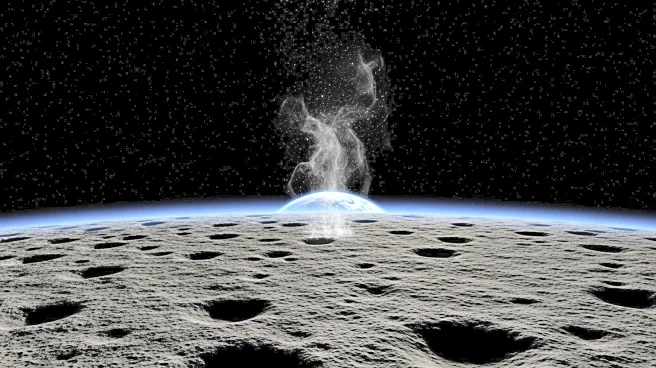
Recent research led by the University of Rochester has uncovered that particles from Earth's atmosphere are reaching the Moon, carried by the solar wind. This study suggests that Earth's magnetic field, traditionally seen as a protective shield, may actually
facilitate the movement of these particles into space and towards the Moon. The research addresses a long-standing question about the presence of certain volatile elements in lunar samples, which could not be fully explained by the solar wind alone. By analyzing lunar soil samples and using computational models, scientists have traced the history of Earth's atmosphere and its magnetic field, revealing that particles such as water, nitrogen, and other life-supporting elements have been deposited on the Moon over billions of years.
Why It's Important?
This discovery has significant implications for understanding the history of Earth's atmosphere and its interaction with the Moon. The lunar soil acts as a long-term archive, preserving a record of Earth's atmospheric changes over time, including shifts due to continental movements, volcanic activity, and human industrialization. This archive could provide valuable insights into ancient climate changes and atmospheric transitions. Additionally, the presence of Earth-sourced volatiles on the Moon enhances its potential as a resource for future lunar missions. If these elements can be efficiently extracted, they could support sustainable human presence on the Moon by providing essential resources like water and air, reducing the need for resupply missions from Earth.
What's Next?
Future research will focus on targeted sampling of lunar soil at various depths and locations to better understand the distribution of Earth-sourced volatiles. Isotopic fingerprinting will be used to distinguish these particles from those originating from the solar wind or comets. Upcoming lunar missions may treat the Moon as both a scientific record and a resource, exploring its potential to support human exploration. This research also opens new avenues for studying atmospheric escape on other planets, such as Mars, and understanding the conditions necessary for planetary habitability.
Beyond the Headlines
The study challenges previous assumptions about Earth's magnetic field and its role in atmospheric particle escape. It highlights the complex interactions between solar wind, magnetic fields, and planetary atmospheres, offering new perspectives on planetary science. The findings also underscore the Moon's role as a stable geological archive, free from the weathering and tectonic activity that alter Earth's surface. This stability makes the Moon an invaluable resource for studying Earth's atmospheric history and could inform future exploration strategies for other celestial bodies.