
What's Happening?
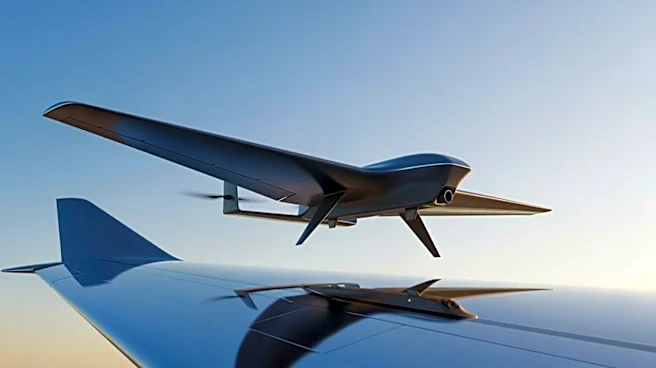
General Atomics has resumed flight testing of its collaborative combat aircraft (CCA) after a seven-week pause due to an autopilot malfunction that resulted in the crash of a YFQ-42A 'Dark Merlin' drone.
The incident, which occurred on April 6 at the company's airport in California, prompted a joint investigation with the Air Force. The investigation identified a software issue related to the autopilot's miscalculation of the aircraft's weight and center of gravity. Following a thorough safety review and software remediation, the YFQ-42A has been cleared to return to the skies. The crash did not result in any injuries, but the aircraft was deemed a total loss. General Atomics is competing with Anduril and Northrop Grumman in the Air Force's drone wingman competition, with a production decision expected by September. The Air Force has requested nearly $1 billion for its first CCAs in the 2027 budget.
Why It's Important?
The resumption of drone-wingman flights by General Atomics is significant for the U.S. military's strategic development of unmanned aerial systems. The incident underscores the challenges and risks associated with advancing drone technology, particularly in the context of military applications. The Air Force's willingness to accept acquisition and test risks, as highlighted by Air Force Col. Timothy Helfrich, reflects a strategic shift towards accelerating the deployment of advanced capabilities. This development is crucial for maintaining technological superiority in military operations, especially in light of emerging threats from global adversaries. The competition among major defense contractors like General Atomics, Anduril, and Northrop Grumman also highlights the growing importance of unmanned systems in future combat scenarios.
What's Next?
The next steps involve continued testing and evaluation of the YFQ-42A and other CCAs as part of the Air Force's broader strategy to integrate unmanned systems into its fleet. A production decision for the CCAs is anticipated by September, which will determine the procurement and deployment timeline. The Air Force's Experimental Operations Unit at Edwards Air Force Base will likely continue to conduct sorties and exercises to validate operational and deployment concepts. The outcome of the competition between General Atomics, Anduril, and Northrop Grumman will shape the future of drone-wingman technology and its role in U.S. military operations.