



What's Happening?
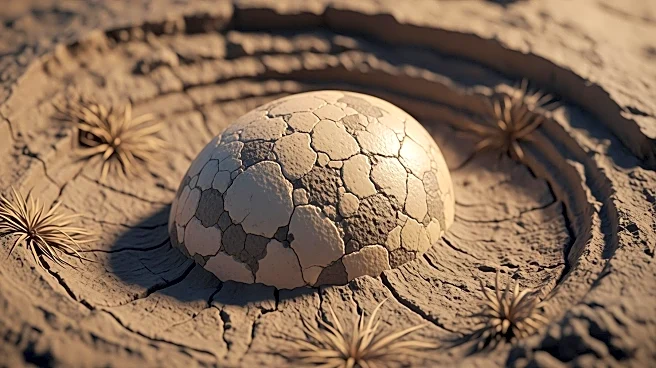
A significant paleontological discovery has been made in southern France, where hundreds of fossilized dinosaur eggs have been unearthed at the Mèze fossil site in the Hérault region. The Muséé-Parc des Dinosaures de Mèze announced the find, highlighting
the exceptional concentration of eggs, some of which are remarkably well-preserved. The eggs, dating back approximately 72 million years, provide valuable insights into dinosaur reproductive behavior and the environmental conditions of the time. The discovery is considered one of the most significant dinosaur egg deposits globally, with some eggs retaining intact internal structures, enhancing their scientific value. The site, a river-laced floodplain, likely preserved the nests through periodic flooding that buried them under sediment. The eggs are attributed to various dinosaur species, including titanosaurs and possibly ankylosaurs or small theropods.
Why It's Important?
This discovery is crucial for the scientific community as it offers a rare glimpse into the reproductive habits and environmental adaptations of dinosaurs. The preservation of the eggs allows researchers to study the embryonic development of these ancient creatures, potentially leading to breakthroughs in understanding dinosaur biology and evolution. The find also underscores the importance of paleontological sites in Europe, contributing to global knowledge about prehistoric life. For the public, such discoveries can enhance interest in natural history and support for scientific research. The museum's announcement has already garnered significant attention, indicating a strong public interest in paleontology and the potential for increased tourism and educational opportunities in the region.
What's Next?
Further excavation and analysis are expected to continue at the Mèze site, with researchers aiming to uncover more eggs and possibly identify additional dinosaur species. The ongoing study of these eggs could lead to new classifications and a deeper understanding of the diversity of dinosaur life in the region. The museum may also collaborate with international paleontologists to expand research efforts and share findings with the global scientific community. Additionally, the site could become a focal point for educational programs and public exhibitions, promoting broader engagement with paleontological research.
Beyond the Headlines
The discovery raises questions about the preservation of ancient ecosystems and the factors that contributed to the exceptional preservation of these eggs. It also highlights the potential for similar finds in other parts of the world, encouraging further exploration of fossil-rich areas. The ethical considerations of excavating and preserving such sites are also important, as they involve balancing scientific inquiry with conservation efforts. The find may inspire discussions about the role of museums and educational institutions in preserving and interpreting natural history for future generations.