







What's Happening?
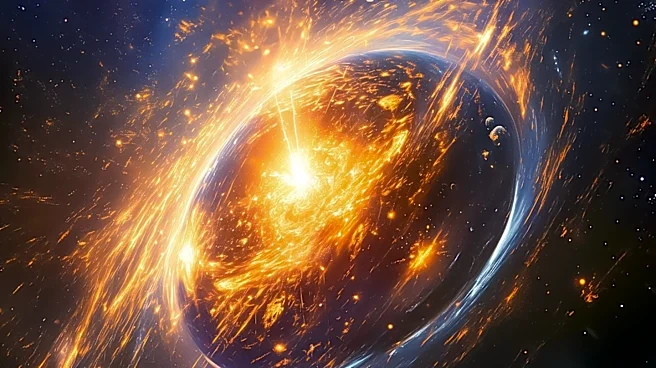
The European Southern Observatory (ESO) has made a puzzling discovery regarding the dead star RXJ0528+2838, located approximately 730 light-years from Earth. Observations using ESO's Very Large Telescope (VLT) revealed a powerful and persistent shock
wave, or bow shock, around this white dwarf. This phenomenon is unexpected because, according to current understanding, a white dwarf without a detectable accretion disk should not be capable of producing such a sustained outflow. The bow shock, described as a curved arc of material similar to a ship's wake, has been active for at least 1,000 years. While the white dwarf possesses a strong magnetic field that could guide material from its companion star, this alone cannot account for the shock wave's longevity, leading astronomers to suspect an unexplained 'mystery engine' is at work. This finding challenges established theories about how dead stars interact with their surrounding environment and exchange matter and energy.
Why It's Important?
This discovery holds significant importance for astrophysics and our understanding of stellar evolution. The unexpected presence and persistence of a shock wave around a discless white dwarf, RXJ0528+2838, directly contradicts current models of how dead stars interact with their environments. If a 'mystery engine' is indeed driving this phenomenon, it implies a fundamental gap in our knowledge of stellar physics, particularly concerning the late stages of a star's life. Understanding this mechanism could lead to a re-evaluation of how matter and energy are exchanged in binary star systems, potentially impacting our understanding of galactic chemical evolution and the formation of various cosmic structures. The long-term implications could extend to refining models of supernova remnants and the life cycles of different types of stars, ultimately enhancing our cosmic inventory and the processes that shape it.
What's Next?
Astronomers plan to conduct further investigations into binary systems to understand how such powerful outflows can form without the presence of accretion disks. The ESO's upcoming Extremely Large Telescope (ELT) is expected to play a crucial role in this research. The ELT's advanced capabilities will allow scientists to study known systems like RXJ0528+2838 and even fainter examples in greater detail. This will enable more precise mapping of these systems and the detection of similar phenomena, which is essential for uncovering the nature of the 'mystery engine' believed to be powering the persistent shock wave. The goal is to gather enough data to develop new theoretical models that can accurately explain these unexpected observations and integrate them into our broader understanding of stellar dynamics and evolution.
Beyond the Headlines
The 'ghost bridge galaxy phenomenon' or the persistent shock wave from RXJ0528+2838, points to a deeper, less obvious implication: the potential for unknown physical processes governing the universe. The concept of a 'mystery engine' suggests that our current understanding of fundamental forces and stellar mechanics might be incomplete. This could lead to a paradigm shift in astrophysics, similar to past discoveries that revolutionized our view of the cosmos. Ethically, this pursuit of knowledge underscores humanity's continuous quest to unravel the universe's secrets, pushing the boundaries of scientific inquiry. Culturally, such discoveries often inspire public interest in science and space exploration, fostering a sense of wonder and encouraging future generations to pursue careers in STEM fields. The long-term shift could involve a more nuanced and complex understanding of stellar death and its profound impact on the surrounding interstellar medium.