
What's Happening?
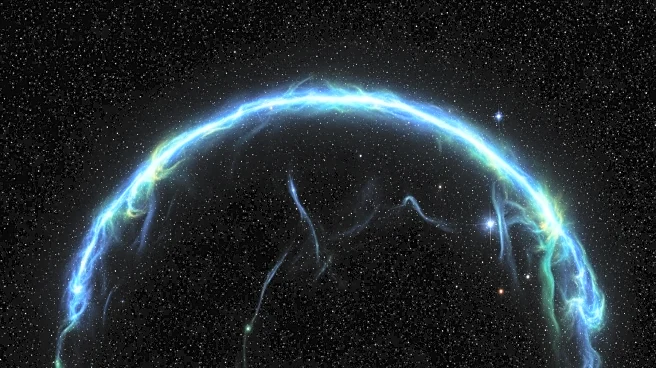
A mysterious arc of glowing gas near the Andromeda Galaxy, discovered by amateur astronomers in 2023, is sparking debate among scientists regarding its origin. The arc, known as the Strottner-Drechsler-Sainty
Object 1 (SDSO-1), emits a glow from oxygen atoms missing two electrons. While some astronomers propose that the arc is a 400,000-year-old aftershock from a planetary nebula, others suggest it might be shock waves from interactions between the halos of the Milky Way and Andromeda galaxies. The arc's large size and faint glow had previously eluded professional surveys, but advancements in digital detectors and imaging techniques have allowed amateurs to capture deeper images. The debate centers on whether the arc is a result of shock waves from a dying star's outer layers or ionized gas from a nearby bright source.
Why It's Important?
The discovery and analysis of SDSO-1 could provide new insights into the late-stage evolution of planetary nebulae and their interactions with interstellar gas. If confirmed as a 'ghost planetary nebula,' this would represent a new class of astronomical objects, offering a unique perspective on how such nebulae merge with their surroundings and contribute to the Milky Way's composition. The findings could also enhance understanding of the dynamics between the Milky Way and Andromeda galaxies, potentially impacting theories about galactic evolution and interaction. The ongoing debate highlights the role of amateur astronomers in advancing astronomical research, as their contributions can lead to significant discoveries that challenge existing scientific paradigms.
What's Next?
Further observations and data collection are needed to resolve the debate over SDSO-1's origin. Accurate measurements of gas motion within the arc could help confirm whether it is a shock wave or ionized gas. Additionally, identifying a nearby ionizing source could support the ionization theory. Researchers are also exploring other potential 'ghost planetary nebula' candidates, which could provide additional evidence for this new class of objects. Continued collaboration between amateur and professional astronomers will be crucial in advancing the understanding of these phenomena.
Beyond the Headlines
The discovery of SDSO-1 underscores the potential for amateur astronomers to make significant contributions to science, particularly with the aid of modern imaging technology. This collaboration between amateurs and professionals could lead to more discoveries that challenge and refine current astronomical theories. The study of ghost planetary nebulae may also have broader implications for understanding the lifecycle of stars and the chemical enrichment of galaxies, as these objects return 'star stuff' to the interstellar medium.