



What's Happening?
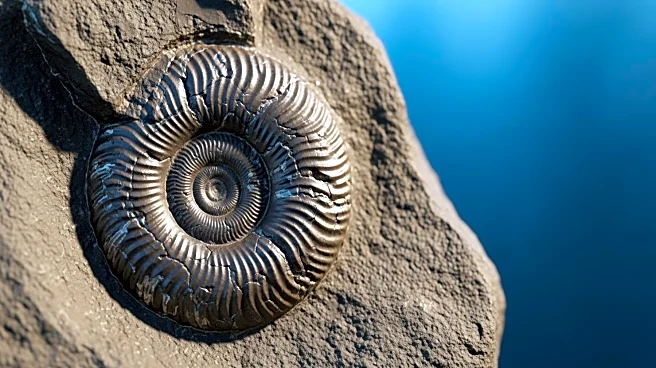
Scientists have discovered 97-million-year-old magnetic fossils that suggest an extinct marine animal may have used Earth's magnetic field for navigation. The fossils, studied by researchers from the University of Cambridge and Helmholtz-Zentrum Berlin,
contain magnetically aligned crystals indicative of magnetoreception. This discovery points to a sophisticated biological system in ancient marine creatures, potentially one of the earliest forms of navigation using Earth's magnetic field.
Why It's Important?
The discovery of these magnetic fossils provides new insights into the evolution of navigation in marine animals. Understanding how ancient creatures used Earth's magnetic field can inform current studies on animal migration and navigation. This research also highlights the complexity of ancient life forms and their adaptations, offering a glimpse into the evolutionary history of sensory systems.
Beyond the Headlines
The identification of these 'giant magnetofossils' suggests that magnetoreception has deep evolutionary roots, possibly predating known migratory behaviors in modern animals. This finding could lead to a reevaluation of how sensory systems evolved in marine environments. Further research may uncover more about the diversity and capabilities of ancient marine life, contributing to our understanding of evolutionary biology.