
What's Happening?
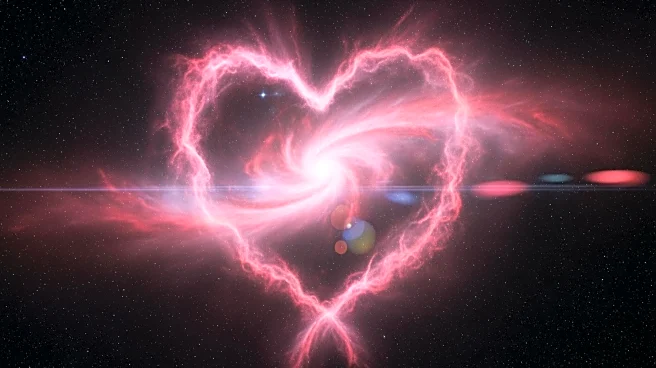
Astronomers have observed a heart-shaped cloud of gas and dust ejected by the red giant star Mira A, located about 300 light-years from Earth. This cosmic phenomenon, coinciding with Valentine's Day, results from the star shedding its layers as it transitions
into a white dwarf. The expelled material, amounting to seven Earth masses, forms a glowing heart-shaped structure in space. The discovery was made using data from the European Southern Observatory's Very Large Telescope and the Atacama Large Millimeter/submillimeter Array. The unexpected scale and symmetry of the ejection challenge existing models of stellar mass loss.
Why It's Important?
The heart-shaped outflow from Mira A provides new insights into the late stages of stellar evolution, particularly the mass loss processes of red giants. This discovery challenges previous models and enhances the understanding of how stars enrich the cosmos with elements that contribute to the formation of new stars and planets. The findings have implications for astrophysics, offering a deeper understanding of the life cycles of stars and the complex dynamics involved in their deaths. The study also highlights the role of advanced telescopes in uncovering the mysteries of the universe.
What's Next?
Astronomers plan to continue monitoring the expanding cloud around Mira A, as it may begin to interact with its companion star, the white dwarf Mira B. This ongoing observation will provide further insights into the dynamics of the ejected material and its impact on nearby celestial bodies. The study of such asymmetrical ejections could lead to revisions in current models of stellar evolution and mass loss. The heart-shaped cloud serves as a reminder of the intricate and often surprising phenomena occurring in the universe.