
What's Happening?
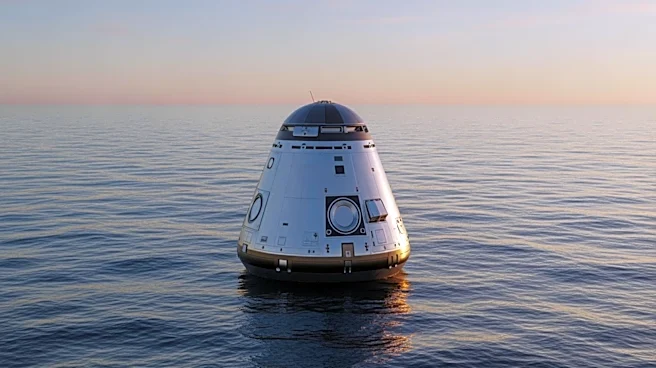
The Artemis II astronauts, including Reid Wiseman, Victor Glover, Christina Koch, and Jeremy Hansen, returned to Earth after a historic 10-day mission around the Moon. The crew splashed down in the Pacific
Ocean near San Diego, marking the end of a journey that set a record for deep space travel. The astronauts were welcomed back at Ellington Field near NASA’s Johnson Space Center with a standing ovation from NASA staff, military officers, and members of Congress. The mission achieved a maximum distance of 252,756 miles from Earth, surpassing the Apollo 13 record. The crew captured unprecedented views of the lunar far side and a total solar eclipse during their voyage.
Why It's Important?
The successful completion of the Artemis II mission is a significant milestone for NASA's lunar exploration program. It demonstrates the capabilities of the Orion spacecraft and sets the stage for future missions, including the planned Artemis III and Artemis IV. The mission's achievements, such as testing critical systems and capturing unique lunar images, contribute to the broader goal of returning humans to the Moon and eventually establishing a sustainable presence. The Artemis program aims to inspire a new generation of space explorers and advance scientific understanding of the Moon and beyond.
What's Next?
NASA is preparing for the next phase of the Artemis program, with Artemis III scheduled to launch next year. This mission will focus on testing docking procedures with a lunar lander in Earth orbit, paving the way for the Artemis IV moon landing in 2028. The success of Artemis II boosts confidence in the program's progress and encourages continued investment and collaboration in space exploration. NASA plans to address technical issues, such as the malfunctioning space toilet, to ensure future missions are equipped for longer durations.