







What's Happening?
A new study by Amirnezam Amiri from the University of Arkansas suggests that some of the galaxy's coldest 'stars' might actually be alien megastructures, known as Dyson spheres. These structures, theorized by physicist Freeman Dyson, are envisioned as swarms
of orbiting structures capturing a star's energy. The study, available on arXiv, explores how these structures might appear through modern telescopes and identifies red and white dwarfs as prime candidates for hosting them. A Dyson sphere would absorb a star's light and re-emit it as infrared heat, altering the star's appearance on the Hertzsprung-Russell diagram.
Why It's Important?
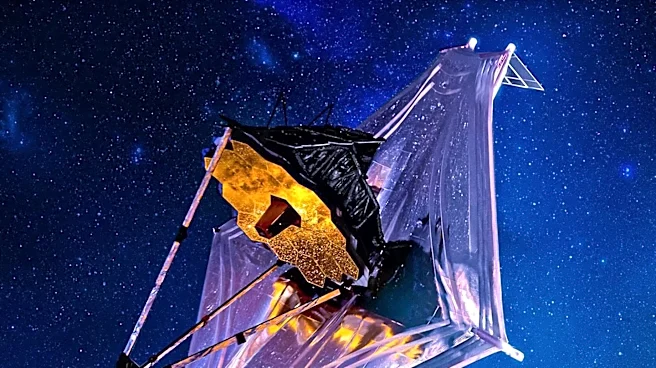
The concept of Dyson spheres is significant in the search for extraterrestrial intelligence, as their detection could indicate advanced alien civilizations. The study provides a framework for identifying potential Dyson spheres by looking for stars with unusual infrared signatures and light curves. This research could guide future astronomical observations and help distinguish between natural cosmic phenomena and potential technosignatures. The findings also highlight the capabilities of telescopes like the James Webb Space Telescope in searching for these structures.
What's Next?
Future observations using infrared telescopes, such as the James Webb Space Telescope, will focus on identifying stars with the predicted infrared signatures of Dyson spheres. The study's findings will guide astronomers in distinguishing between natural and artificial structures in space. Continued research and observations may eventually confirm the existence of Dyson spheres, providing evidence of advanced extraterrestrial civilizations.