






What's Happening?
Archaeologists investigating a Mongol invasion ship from 1281 off the coast of Japan have discovered 34 gaming pieces, including five dice and 29 rectangular stones. The discovery, announced in October 2026, marks the first time such gaming artifacts
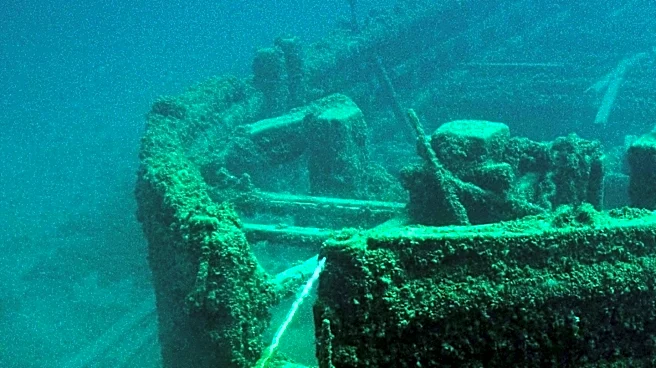
have been found among the Mongol invasion shipwrecks in the area. Professor Yoshifumi Ikeda of Kokugakuin University, along with researchers from the Matsuura City Board of Education, examined the stern of a ship located about 150 meters from shore at a depth of 18-19 meters. The ship, potentially 30 meters long, could be the largest of the three invasion wrecks identified in the region. The gaming pieces, resembling those used in traditional Chinese games like Tianjiu, were found alongside iron objects believed to be food containers, a grinding bowl, and a knife, suggesting the stern housed a food preparation area. This finding leads archaeologists to hypothesize that those tasked with food preparation may have played games during breaks.
Why It's Important?
This discovery offers a unique glimpse into the daily life aboard Kublai Khan's invasion fleet, providing a human element to a historical event often viewed solely through a military lens. The presence of gaming pieces alongside kitchen artifacts suggests that even during a major military campaign, there were moments of leisure and personal activity among the crew. This challenges the perception of a purely militaristic environment and enriches our understanding of the social dynamics and routines of historical naval forces. For archaeologists, these artifacts provide tangible evidence of cultural practices and potentially shed light on the types of games played in 13th-century China and Mongolia, offering a connection to the historical development of games like mahjong. The ongoing research at the Takashima seabed continues to be a crucial site for understanding this failed expedition, offering new insights beyond just military strategies.
What's Next?
Researchers will continue to analyze the discovered gaming pieces to identify the exact game they belonged to and further explore their connection to traditional Chinese games. The ongoing excavations at the Takashima seabed are expected to yield more artifacts, potentially offering additional insights into the daily lives, cultural practices, and logistical challenges faced by Kublai Khan's invasion forces. Further evaluation of the preserved ship remains will aim to confirm its estimated length and structural details, which could establish it as the largest of the identified invasion wrecks. The archaeological community will likely continue to monitor these findings for their contributions to understanding medieval naval history and cultural exchange.
Beyond the Headlines
The discovery of gaming pieces in a sunken invasion fleet transcends mere archaeological interest, offering a profound human connection to a pivotal historical event. It underscores the universal human need for recreation and social interaction, even in the most arduous and dangerous circumstances of war. This finding subtly challenges the often-impersonal narratives of historical conflicts by revealing the personal lives of individuals involved. It also highlights the resilience of culture, as games and leisure activities persisted even amidst the harsh realities of a military campaign. The 'kamikaze' narrative, traditionally associated with the typhoon that destroyed the fleet, gains a new dimension when juxtaposed with evidence of ordinary life, reminding us that history is a complex tapestry woven from grand events and individual experiences.