



What's Happening?
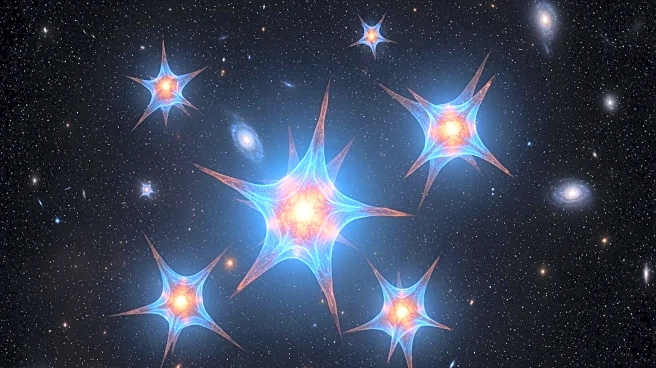
The James Webb Space Telescope has potentially discovered the first evidence of massive 'dinosaur-like' stars that existed shortly after the Big Bang. These stars, theorized to have masses up to 10,000 times that of the sun, are believed to have existed in the early
universe and contributed to the formation of supermassive black holes. The discovery was made while examining the chemical composition of a distant galaxy, GS 3073, located approximately 12.7 billion light-years away. The galaxy's unusual nitrogen-to-oxygen ratio suggests the presence of these primordial stars, which would have burned brightly for a short period before collapsing into black holes. This finding helps solve a long-standing cosmic mystery about the early universe's stellar population.
Why It's Important?
This discovery is significant as it provides insight into the early universe's conditions and the formation of supermassive black holes. Understanding these ancient stars' existence and their role in shaping early galaxies can help astronomers piece together the universe's evolutionary history. The presence of such massive stars suggests that the first generation of stars included supermassive objects, which may have seeded today's supermassive black holes. This knowledge could lead to a better understanding of galaxy formation and the chemical enrichment of the universe over billions of years.
What's Next?
The research team plans to search for other early nitrogen-rich galaxies to strengthen the evidence for these massive primordial stars. By identifying more galaxies with similar chemical signatures, scientists can confirm the existence of these stars and further understand their impact on the early universe. This ongoing research could provide more clues about the processes that led to the formation of supermassive black holes and the evolution of galaxies.
Beyond the Headlines
The discovery of these 'dinosaur-like' stars highlights the complexity and diversity of the early universe. It challenges existing models of star formation and suggests that the universe's first stars were more varied than previously thought. This finding also underscores the importance of advanced telescopes like the James Webb Space Telescope in uncovering the universe's hidden secrets and expanding our understanding of cosmic history.