






What's Happening?
Recent research suggests that planets may form more efficiently around binary star systems than around single stars like the sun. Binary star systems, where two stars orbit each other, are common in the Milky Way. Historically, these systems were thought
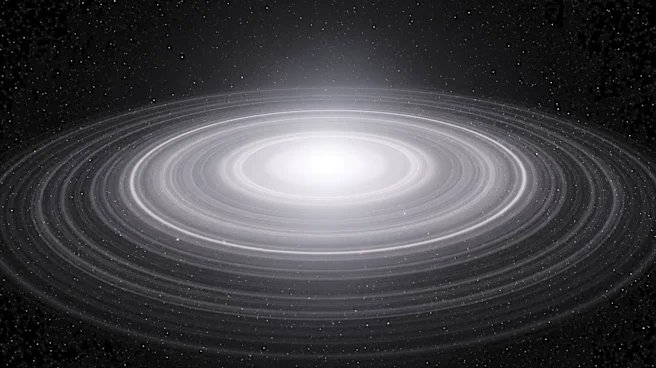
to be hostile to planet formation due to competing gravitational forces. However, the new study indicates that while the inner regions of these systems are too chaotic for planet formation, the outer regions may actually be conducive to planet formation. Using computer simulations, researchers modeled protoplanetary disks around young binary stars, revealing that regions close to the stars are too turbulent for planets to form. Beyond this 'forbidden zone,' the disk can become unstable enough to fragment and form planets, particularly large gas giants. This finding suggests that planets like the iconic twin-sun world Tatooine may be more common than previously thought.
Why It's Important?
The discovery that planets can form more easily around binary stars challenges previous assumptions about planet formation and could significantly impact our understanding of the universe. This research opens new avenues for observation, potentially allowing astronomers to witness planet formation in real-time using powerful instruments like the James Webb Space Telescope. The findings also suggest that circumbinary planets, which orbit two stars, may be more prevalent than previously believed. This could lead to a reevaluation of the conditions necessary for planet formation and survival, influencing future astronomical studies and the search for habitable planets.