
What's Happening?
The International Energy Agency (IEA) has released its Renewables 2025 report, projecting a significant increase in global renewable power capacity, expected to double by 2030. This growth is primarily
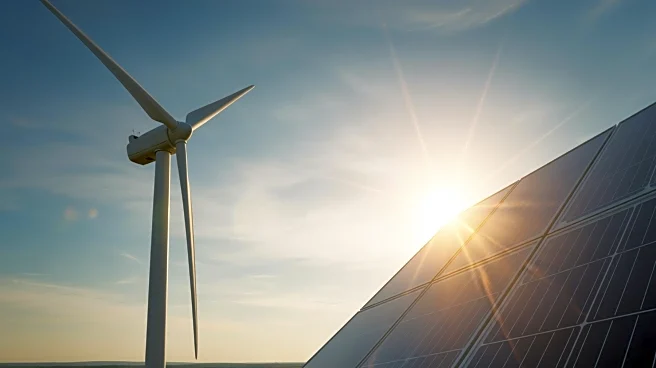
driven by solar photovoltaic (PV) technology, which is anticipated to dominate the expansion of renewable energy sources. The report highlights that this increase is equivalent to adding the combined generation capacity of the European Union, China, and Japan, all from clean energy sources. Despite this positive trajectory, the report suggests that the global community may fall short of the COP28 goal of tripling renewable power capacity by the end of the decade. The report also notes that while the European Union has met its 2025 solar capacity target, future targets for 2030 are at risk, with a decrease in solar power additions expected this year compared to last.
Why It's Important?
The doubling of renewable power capacity by 2030 is a critical development in the global effort to transition to sustainable energy sources and combat climate change. This growth in renewable energy, particularly solar PV, represents a significant shift in the energy landscape, reducing reliance on fossil fuels and decreasing greenhouse gas emissions. The IEA's report underscores the importance of continued investment and innovation in renewable technologies to meet international climate goals. The potential shortfall in achieving the COP28 target highlights the challenges that remain in scaling up renewable energy deployment. This development has significant implications for energy policy, economic investment, and environmental sustainability, affecting industries, governments, and societies worldwide.
What's Next?
Looking ahead, the focus will likely be on addressing the challenges that hinder the rapid deployment of renewable energy technologies. This includes overcoming market-related bottlenecks such as funding and planning, as well as enhancing grid capacity to accommodate increased renewable energy generation. The IEA's report suggests that continued innovation and investment in technologies like solar PV and energy storage will be crucial. Additionally, international cooperation and policy alignment will be necessary to achieve the ambitious targets set for 2030 and beyond. Stakeholders, including governments, businesses, and civil society, will need to collaborate to ensure that the momentum in renewable energy growth is sustained and accelerated.
Beyond the Headlines
The report's findings also highlight the broader implications of the energy transition, including the potential for economic growth and job creation in the renewable energy sector. As countries invest in clean energy infrastructure, there is an opportunity to drive economic development and create new employment opportunities. However, the transition also poses challenges, such as the need to retrain workers from traditional energy sectors and address the social and economic impacts of shifting away from fossil fuels. The report emphasizes the importance of a just transition that considers the needs of all stakeholders and ensures that the benefits of renewable energy are equitably distributed.