



What's Happening?
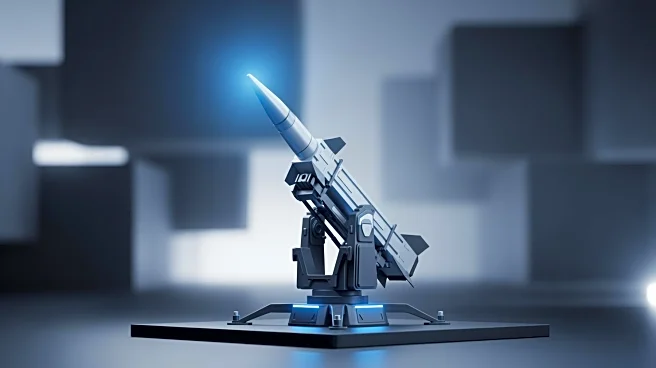
British defense firm Babcock and Estonian startup Frankenburg Technologies have announced a collaboration to develop a containerized launch system for low-cost missiles. This initiative aims to provide affordable maritime defenses against one-way attack
drones. The partnership, formalized through a memorandum of understanding, seeks to create a new and affordable maritime counter-drone air-defense system. Engineering efforts will be led from the United Kingdom, with the goal of establishing a new sovereign capability. Frankenburg Technologies, led by CEO Kusti Salm, is focused on producing missile systems that are significantly cheaper and faster to manufacture than current industry standards. The Mark 1 missile, touted as the world's smallest guided missile, is central to this project. It is designed for mass production and is powered by a solid-fuel rocket motor. The missile was developed from concept to live firing in just 13 months.
Why It's Important?
The collaboration between Babcock and Frankenburg is significant as it addresses the growing threat of drone warfare, which has become a prominent feature on modern battlefields, particularly in Ukraine. The development of cost-effective and scalable defense solutions is crucial for military personnel and critical infrastructure protection across Europe. This partnership not only aims to enhance European defense capabilities but also opens up global export opportunities. The rapid production capabilities of Frankenburg's missile systems could revolutionize the defense industry by providing quick and affordable solutions to emerging threats. This development is particularly relevant as nations seek to bolster their defenses against increasingly sophisticated and accessible drone technologies.
What's Next?
The next steps for Babcock and Frankenburg involve accelerating the delivery of an operational maritime capability. The companies plan to establish production facilities in Estonia's new Defence Industry Park, with an initial production capacity of 100 short-range air-defense missiles per day. Additionally, Frankenburg has signed an agreement with Polska Grupa Zbrojeniowa to integrate its missiles on PGZ platforms, with plans to establish local manufacturing capacity for up to 10,000 units annually. These developments indicate a significant scaling up of production and deployment capabilities, which could have a substantial impact on European defense strategies.