



What's Happening?
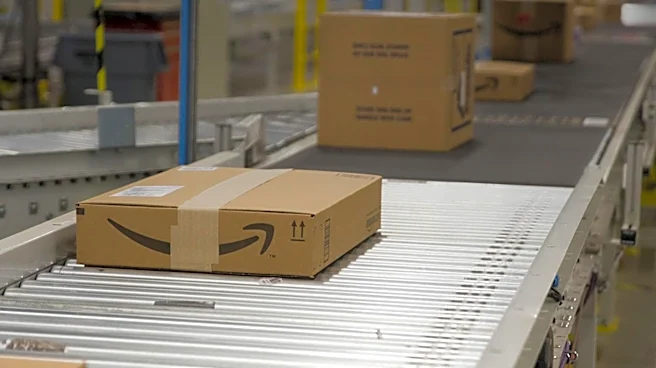
The National Labor Relations Board (NLRB), an independent federal agency responsible for enforcing U.S. labor law in private sector industries, has ordered Amazon to bargain with a unionized group of workers at its JFK8 Fulfillment Center in Staten Island.
This directive follows a 2022 vote by workers at the facility to form a union, which Amazon has reportedly refused to acknowledge. The NLRB's involvement underscores its role in overseeing labor relations, including union organizing and addressing unfair labor practices. Amazon is known for its anti-union stance, employing various tactics to deter unionization efforts. These tactics, as revealed in documents related to anti-union activity, include systematic monitoring of employee feedback through mechanisms like 'Connections' questions and 'Voice of the Associate (VOA) Boards,' which are analyzed using machine learning to track potential labor unrest. Managers are also trained on what they can and cannot do during union drives, emphasizing a 'direct working relationship' with employees over union representation.
Why It's Important?
This NLRB order is significant for U.S. labor relations, particularly in the context of large corporations like Amazon. It reinforces the legal framework that protects workers' rights to organize and collectively bargain, as enforced by the National Labor Relations Act. For Amazon, a company that has historically resisted unionization, this order could set a precedent for how it engages with organized labor in the future. The company's sophisticated anti-union strategies, which involve extensive surveillance and carefully crafted managerial training, highlight the challenges faced by workers attempting to unionize in the modern economy. The outcome of this bargaining order could influence unionization efforts across the logistics and e-commerce sectors, potentially empowering more workers to seek collective representation and altering the power dynamics between large employers and their workforce. It also brings into focus the effectiveness of current labor laws in addressing contemporary corporate anti-union tactics.
What's Next?
Following the NLRB's order, Amazon is legally required to engage in collective bargaining with the unionized workers at the JFK8 Fulfillment Center. The immediate next step will involve the commencement of negotiations between Amazon and the union representatives. However, Amazon's history suggests that this process may be protracted and potentially contentious. The company could explore legal avenues to challenge the NLRB's order, which might include appeals to higher courts. The NLRB will likely continue to monitor Amazon's compliance with its directive, and any further refusal to bargain could lead to additional legal actions or penalties against the company. The situation could also galvanize further union organizing efforts at other Amazon facilities across the U.S., especially in 'high-risk' sites identified by Amazon's internal tracking systems, such as the KCVG air hub or the DJT6 warehouse in Riverside, California. The broader labor movement will be closely watching these developments as a test of the NLRB's authority and the future of unionization in the tech and logistics industries.
Beyond the Headlines
Beyond the immediate legal and labor implications, this case sheds light on the evolving nature of corporate control and employee relations in the digital age. Amazon's use of advanced data analytics and machine learning to monitor employee sentiment and predict unionization risks raises ethical questions about worker surveillance and privacy. The company's strategy of 'scripted empathy' in manager training, designed to foster a direct relationship with employees while subtly discouraging union affiliation, reveals a sophisticated approach to managing labor unrest that goes beyond traditional anti-union tactics. This development could prompt a broader discussion about the balance between corporate efficiency and employee rights, potentially influencing future legislative efforts to update labor laws in response to new corporate strategies. The long-term impact could be a re-evaluation of what constitutes fair labor practices in an economy increasingly dominated by large, technologically advanced corporations, and how regulatory bodies can effectively enforce worker protections against such sophisticated methods.