






What's Happening?
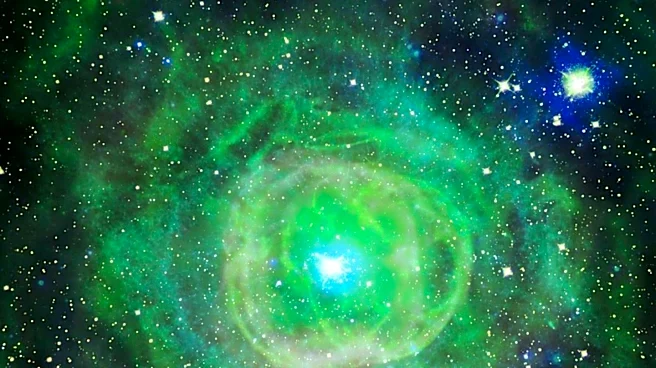
Astronomers have discovered the first-ever genuinely green star, a white dwarf designated WD J1330+6435, located approximately 326 light-years away. This finding challenges the traditional understanding that a star's color is almost entirely determined
by its temperature. White dwarfs, the remnants of sun-sized stars, typically appear white or pale blue. However, new research led by Mark Hollands of the University of Warwick suggests that these dense stellar corpses can exhibit a range of colors, including green, pink, cyan, yellow, and purple, if they 'snack' on planetary material. WD J1330+6435 has been accreting rocky material from a planetary companion, enriching its atmosphere with elements like calcium, lithium, and sodium. The presence of sodium absorbs the orange part of the spectrum, resulting in a ghostly green glow. The team also identified what could be the reddest star ever, WD J1011+2845, a white dwarf with a deep salmon-pink glow due to carbon molecules distorting light.
Why It's Important?
This discovery significantly expands our understanding of stellar evolution and the diverse properties of white dwarfs. It reveals that the universe is far more colorful than previously suspected, challenging long-held astronomical assumptions about star coloration. For U.S. astronomy and space research, this opens new avenues for studying the chemical composition of stellar atmospheres and the processes by which white dwarfs interact with their surrounding planetary debris. The ability of white dwarfs to take on unusual colors due to planetary consumption provides insights into the fate of planetary systems after their host stars die, potentially offering clues about the future of our own solar system. This research also highlights the advanced capabilities of modern astronomical observation and modeling in uncovering previously unseen cosmic phenomena.
What's Next?
Astronomers will likely conduct further observations of WD J1330+6435 and other white dwarfs to confirm and expand upon these findings. The research team will continue to refine their models to better understand the specific chemical interactions that produce these unusual colors. Future studies may focus on identifying more 'oddly colored' white dwarfs and analyzing their atmospheric compositions to correlate specific elements with observed hues. This could lead to a new classification system for white dwarfs based on their spectral characteristics and the presence of accreted planetary material. The discovery may also inspire new theoretical work on stellar physics and the long-term evolution of planetary systems, potentially influencing the search for exoplanets around white dwarfs.
Beyond the Headlines
The concept of 'cosmic zombies' that 'snack' on planets adds a dramatic, almost science fiction-like dimension to our understanding of the universe. This imagery captures public imagination and can inspire greater interest in astronomy and space science. Beyond the scientific implications, the discovery of a green star challenges our intuitive understanding of color in the cosmos, which is often limited to the familiar red, orange, yellow, and blue of main-sequence stars. It underscores the vast and often unexpected diversity of phenomena in space. The fact that only a small fraction of white dwarfs exhibit these unusual colors (estimated at one in 30) suggests that specific conditions are required for such coloration, making these discoveries even more unique and valuable for scientific inquiry into the extreme physics of stellar remnants.