


What's Happening?
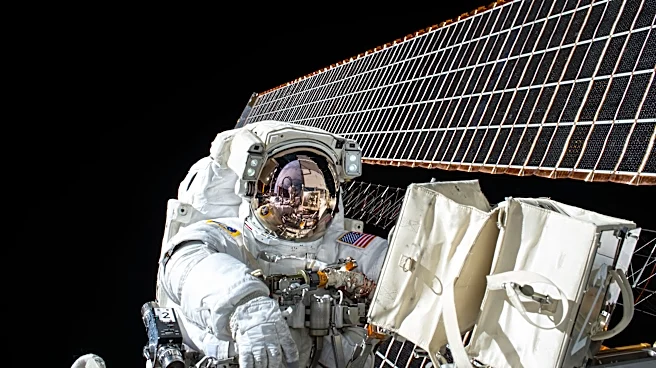
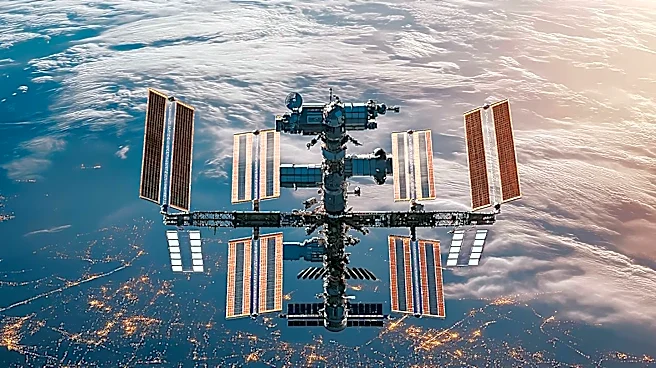
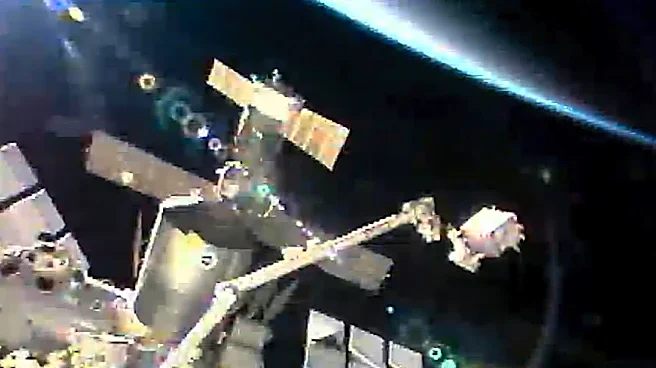
NASA astronaut Anil Menon and CSA (Canadian Space Agency) astronaut Joshua Kutryk successfully completed a spacewalk to install the eighth and final International Space Station Roll-Out Solar Array (IROSA). The spacewalk, which lasted six hours and 59
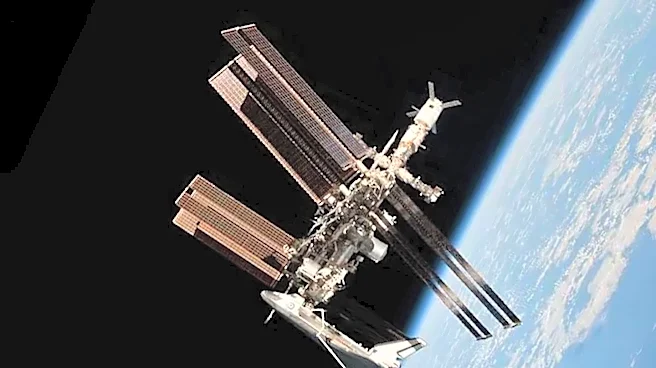
minutes, saw the astronauts deploy the new array on the 3B channel of the space station's starboard truss structure. This installation marks the completion of the power augmentation upgrades for the orbital outpost, a project that began in February 2021. Over the course of 18 spacewalks, astronauts have prepared power channel equipment and installed all eight IROSAs. These new arrays significantly increase the station's power generation capacity from 160 kilowatts to approximately 215 kilowatts, enhancing its operational capabilities. This spacewalk was Menon's fifth and Kutryk's second, and it was the 286th spacewalk in support of space station assembly, maintenance, and upgrades.
Why It's Important?
The successful installation of the final IROSA is a critical milestone for the International Space Station (ISS), ensuring its continued operational longevity and scientific productivity. The increased power generation capacity is vital for supporting ongoing research, future experiments, and the station's life support systems. As the ISS continues to host a wide array of international scientific endeavors, the enhanced power supply allows for more sophisticated and power-intensive investigations in microgravity, benefiting fields from biology and medicine to materials science and astrophysics. This upgrade also demonstrates the ongoing commitment to maintaining and enhancing the capabilities of the ISS as a unique orbiting laboratory. The successful completion of this multi-year project, involving numerous spacewalks, underscores the complexity and precision required for in-space assembly and maintenance, showcasing the advanced capabilities of human spaceflight and international collaboration.
What's Next?
With the completion of the power augmentation upgrades, the International Space Station is now equipped with enhanced electrical capacity, which will directly support its scientific mission and operational needs for the foreseeable future. The increased power will enable more extensive and power-demanding experiments, potentially leading to new discoveries in various scientific disciplines. NASA and its international partners will continue to utilize the ISS as a platform for research, technology demonstration, and human spaceflight preparation for future missions to the Moon and Mars. The successful deployment of the IROSAs also provides valuable experience and data for future space infrastructure projects, including potential lunar gateways or orbital outposts. The focus will now shift to maximizing the utilization of this enhanced power for scientific returns and maintaining the station's overall health and functionality.
Beyond the Headlines
The completion of the IROSA installation project represents more than just a power upgrade; it symbolizes the continuous evolution and adaptability of human endeavors in space. The roll-out solar array technology itself is a significant advancement, offering a more compact and efficient way to deploy large solar arrays in space compared to traditional rigid panels. This technology has implications for future spacecraft design, potentially enabling larger and more powerful missions with reduced launch volume and mass. Furthermore, the extensive series of spacewalks required for this project highlights the critical role of extravehicular activity (EVA) in space exploration. The skills and procedures refined during these spacewalks contribute to the collective knowledge base for future complex in-space construction and maintenance tasks, which will be essential for establishing sustainable human presence beyond low Earth orbit. It underscores the human element as indispensable in the intricate dance of space engineering.